Showing posts with label character building. Show all posts

Wednesday, February 15, 2017

The Business of Writing: Characters: Make the Reader Care

By: Linda Rohrbough

One of the things I heard about my work when I first started writing fiction was readers cared about my plot, but they didn’t care about the characters I’d created. So my question was, how do you create characters readers care about?

I’d done my best up until that point to create the characters I saw in my head, so I was clueless as to how to make readers care about these people who were so real to me. But the answer is actually quite simple.

Tags.

Motivation.
Let’s take tags first. Tags is the term in fiction writing given to character traits the reader can “see.” I learned them when I had three walk-on characters all dressed the same in a prison environment, who readers told me they couldn’t tell apart. And it got confusing for my readers. So another writer said give them tags, short but specific physical characteristics that are different for each one. A big space between a character’s front teeth, big hair, rhinestone glasses, a limp, a mannerism like rubbing their eyes a lot, and so on. So I gave each of those three walk-on characters, a unique tag. And it worked.

Watch people and you’ll see all kinds of tags you can make use of in your fiction. For example, one of the cheapest tricks in the book is to give a character a cold or an allergy– especially a walk on character. The writer has this character sneezing on others, or wiping their nose, or doing something related to having a cold or an allergy, and that sticks in the reader’s mind. Any time a character comes on to the “set” with cold or allergy symptoms, the reader will assume it’s the same character.

The classic example of this from my TV youth was Columbo. The character played by Peter Falk was always in a wrinkled beige trench coat carrying a cigar he never smoked with one eye askew. And he was kind of clumsy physically and socially. But he was smart and people always underestimated him. We loved that. And we remembered him. If you recall, no one else on the show was dressed like him or behaved like him.

I am constantly looking for fresh tags I can use in my writing when I watch people around me. I started dancing as a counter to sitting around writing all the time. Dancers are a great source for tags, especially in couple’s dancing. For example, there’s the guy with the plastic black framed glasses that are too big for his face that he constantly pokes back into place with his forefinger. And he wears big black shoes that look clunky, but he’s cut and glued a chamois to the soles, so he can glide on the dance floor in those shoes. And it turns out he used to be a dance instructor, so he’s actually a pretty good dancer. And he’s almost always in a short-sleeved collared sports shirt that’s some shade of teal. See, you’re already involved with this guy. I didn’t tell you his name or how tall he is or how old but you’ve already got a picture of him in your head.

Notice I didn’t have to give a lot of details. Just a few, and the reader will fill in the blanks. In fact, that’s one of the things I don’t like about television and movies, especially if they are remaking a book. I prefer the pictures I have in my head of the characters to what the producer came up with.

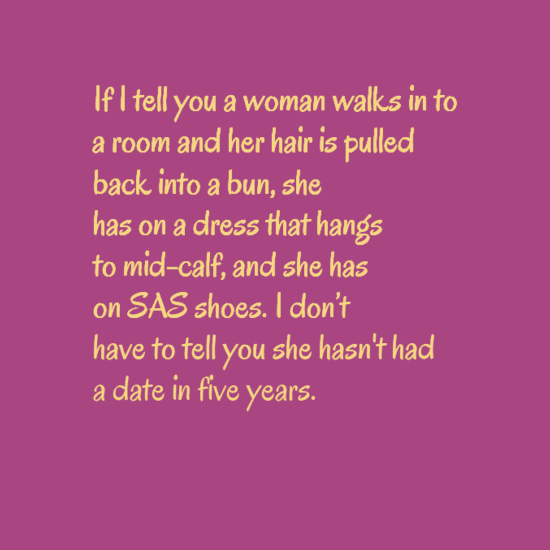
Here’s an illustration of tags I like to use in my writing classes. If I tell you a woman walks in to a room and her hair is pulled back into a bun, she has on a dress that hangs to mid-calf, and she has on SAS shoes. I don’t have to tell you she hasn’t had a date in five years. And notice you don’t have to know what SAS shoes are to get the picture they look like dark-colored versions of the shoes nurses wear. You made that up in your head, too.

If I wanted to surprise the reader, I could have all the men in the room vying for her attention. I could even put a beautiful blonde cheerleader type in the corner of the room that everyone is ignoring. Now the reader will want to know why the men pay attention to the SAS shoe gal and not the cheerleader, and the reader will start to make up reasons in their head. And I’ve already got a story brewing because I created conflict with my tags.

So you need tags. And if you don’t have them, even if you’ve gone into long detailed descriptions about your character’s appearance, your reader won’t remember. In fact, I avoid long, detailed descriptions about anything. I like to paint the picture with a few well-chosen strokes that are playing double and triple duty, like I did in my SAS shoe gal example. It’s fun and elegant to create a brief description that sets up potential conflict, and plays off the reader’s assumptions and stereotypes.

Motivation is another thing that will help your reader care about your characters. I recently was in an airport that had a special table in front of a bookstore which had multiple copies of two paperback versions of The Girl On The Train by Paula Hawkins with different covers, and then a hard back version. But no other books on the table. So I asked the bookseller why. And when he explained one paperback was the original version written by the author, and the other was the movie version of the book, and that both paperbacks would cost the same as the original hard-cover version, I bought the two paperbacks. Since I’ve done some writing for television, I wanted to compare the original to the movie version.

I had time on the plane so I started with the original paperback version, and I can tell you had it not been a New York Times best-seller, I would have put it down after about five pages, then deposited the book in the nearest paper recycling bin once I got off the plane. Because the girl on the train was someone I didn’t like at all. And it was because her motivation was nothing short of selfish and despicable, when there was any. Most of the time she was like a leaf blowing in the wind with no motivation whatsoever. It’s a principle of fiction that readers don’t like victims and this gal was definitely in victim mode.

My friend, and multiple Spur award-winning western author, Dusty Richards says your character needs to be motivated toward a goal and that you cannot remind the reader too many times of what that goal is.

I don’t know if I need to mention this, but the character’s main goal is always broken down into sub-goals. For example, let’s say there’s an old-west sheriff character on horseback. He can barely see in the moonlight. But he needs to make it over the next rise before sunrise to  the bad guy's camp to see if the thief he's after is in his bunk, and can be apprehended. The goal is to catch the thief, but the sub-goal is to make it over the next rise by sunup.

And, of course, there are obstacles to each goal, which is what keeps the reader engaged and the story moving. The character should have deeper motivation, usually produced by a painful past, that drives him as well. Like our cowboy sheriff hates thieves because a thief stole grandma’s fall harvest back when the character was a little tyke and grandma died that next winter.

The obstacles also need to be reasonable obstacles, not ones the character creates by their own stupidity. In the romance writing world, they have an acronym for this mistake in character development: characters who are TSTL (Too Stupid To Live). Readers are not interested in “I Love Lucy” plots where it’s all about manipulation and deception for some inane goal, like an elaborate deception to keep Ricky from finding out Lucy spent $5 more on groceries this week than the budget allows.

And The Girl On The Train so reminded me of “I Love Lucy,” only not as kind and gentle. It began with a good fifty pages of boring narrative about this woman who rides a commuter train back and forth past a row of houses every day, laced with detailed descriptions of the landscape, houses and the players, in between bouts of this woman drinking herself into a stupor at night. We finally get to something happening many chapters in, which is a murder. But even then, the main character was TSTL until nearly halfway through the book. What made it all worthwhile was the really satisfying ending, which of course, I had my doubts would actually happen in real life. But it was accomplished by a secondary character I had some respect for, who was helped by the main character, and that made it somewhat plausible.

I’m sure in a case like this, the author would argue people really behave the way she wrote them. And I agree. That does not mean, however, that I’m willing to pay money to put up with reading about it. (I did a little research and found out Paula Hawkins is British journalist, and I hear the Brits are accustomed to this take-a-while approach to getting into a story.) The only thing that kept me going was all the hoopla about the book, which I still think was rather unfounded. But I can see how the ending would strike a chord with women, who are the main readers of fiction. So I get it.

Now away from the book review and back to my subject, tags and motivation are the two things writers can utilize to make readers care. If you don’t have those two things, readers aren’t going to care. And they really want to care, so they’re disappointed when they can’t or don’t. Making the reader care is part of the job as a writer, but it’s not particularly hard work if you know what you’re doing. And I think it’s fun work – clever tags coupled with motivation that’s obvious and deeper motivation peeled back in layers. That’s the ticket.

Now, to be quite honest, we all stand on the shoulders of giants, and I’m no exception. I have several writers to thank for this information, including my romance writing friends, specifically Debbie Macomber and Jodi Thomas. Romance is very character driven, so those gals were a big help to me. And Dusty Richards, who is quite a character in his own right in his ten-gallon white hat and hands so big he has to buy special keyboards with extra wide keys to keep from “fat fingering” when he types his manuscripts.

I also want to thank the people who gave me feedback, because that consistent feedback created a tangible problem that I could then take to the “big boys.” But even with help, it took a while for me to wrap my head around this.

So if you’ve gotten the “I don’t care about these characters” feedback, then give your characters tags and motivation. If you think you already have, make changes anyway, and see if you can hit on a something that works for you. Because if you can make the reader care about your characters, that’ll keep them engaged in your story.

Bio: Linda Rohrbough has been writing since 1989, and has more than 5,000 articles and seven books to her credit, along with writing for television, and seven national awards for her fiction and non-fiction. An iPhone App of Linda’s popular “Pitch Your Book” workshop is available in the Apple iTunes store. Find her on Facebook as “Linda Rohrbough – Author” or visit her website: www.LindaRohrbough.com.

Monday, April 18, 2016

Character Profiling -- Are You Missing the Spark?

By: Kathie Scrimgeour

Do your characters seem to be missing that spark? Are they feeling flat as the paper they are being written on? Maybe you need to do an in depth profile of that character. You already did one? You might consider refreshing it.

Character profiling (also referred to as character traits) will transform a fuzzy idea of a person into a full-fledged living and breathing individual. Put yourself into the mind and body of your character and ask some questions that range from the generalities – the traits - (full name, birthday, place of birth, hair color, body type and more), to in-depth – the profile - (strangest talent, dark secrets, favorite poem, do they sleep in the buff?)

Once you have answered these questions delve even further. When faced with a life or death situation, how will they react? Take care that the reaction belongs to the character and not to you. Ask yourself why the character is behaving the way they are. What life experience would result in them running away rather than drawing a sword and fighting to the death? Was it from past experience they know not to fight an ogre three times their size, or were they kidnapped and tortured by an adult who left an ogre-sized shadow in your character’s memory?

Don’t forget they are more than just consciousness on a page. For them to truly fill their lungs they need air to breathe, an environment that fills their senses. If they were to close their eyes how would the room feel to them? Do they lose their sense of balance with closed eyes? What do they smell, taste, feel on their skin? Dig deep into them. Go beyond the five senses and explore their intuition, those gut feelings. An ache deep in a person’s belly can reveal the depth of their emotions. How does their body fit into the space they stand? The further you climb into a character’s mind and body the deeper they will breathe.

Take the time to develop your top characters to the point that you can imagine them sitting down with you for a chat. Write out a list of questions to ask them as if you are getting to know someone for the first time. A few examples after you are done with the basics:

  • If you are outside, what are you most likely to do?
  • What was the last lie you told?
  • What is your favorite animal?
  • What is your most treasured thing?
  • Have you ever caught a butterfly? What was it like?
  • What are you most afraid of?

Understand every nuance, innuendo, and attribute of your main players. Give them a background, a scope, and a point of view. With extensive knowledge of your characters they will rise off the paper and fill your reader’s imagination. 

Wednesday, February 17, 2016

Ways to Shade Characters

By: Karen Albright Lin

Your princess bride, bratty urchin, and curmudgeonly gumshoe need qualities that distinguish them from all others. Defining them with a telling word or two can give readers a taste, but there are hundreds of vivid ways to shade characters to bring them alive. One way is to let their external worlds symbolize their internal worlds.


One technique is to link a character’s vocation to a consuming passion: palm reading, coin collecting, or sculpting. If your main character goes to conventions to buy and exchange lariats, he has a place to run into conflict related to your plot. At the end of the book, your character and reader may never look at a noose the same again. That's part of the magic of writing: you never stop learning. Even more rewarding: you teach your readers something. Molière believed the purpose of theater was to entertain and to educate. That can be applied to fictional personalities’ endeavors. How education is earned and applied is a result of your characters’ qualities.

A hobby can be a demonstration of a character’s natural traits. Consider two of your heroine’s most outstanding traits (one good, one bad). Then lace both together in the form of an interest or obsession or quirk (Dr. Temperance 'Bones' Brennan’s seeming lack of emotion) or a distraction (Janet Evanovich’s hamster, Rex). Weave an avocation carefully into a subplot. It’s best to have it play a real role in the plot, not simply exist in the book.

Those good and bad traits can play even bigger roles; perhaps your man tries to hide the negative trait but unsuccessfully (Marty McFly’s lack of courage). Maybe a good trait gets your character into the most trouble. Or the bad trait solves the problem (Monk’s OCD).  

Distinctive traits can be conveyed through dialogue. Characters could speak past each other; that allows the reader to hear something important yet know that a character missed the vital point communicated by the other. Your protagonist could notice but interpret statements wrongly or want to attribute them to something else. And there's the overheard conversation or an antagonist grumbling under his breath about something that shouldn't set him off. If you hit a snag, think of the sleaziest person you know and make that come out in little snippets here and there.  

Different character traits allow you to capture degrees of discomfort and to insert varying ways of handling “mixed signals” from other characters. A suspect is being nice, but his vibes feel a bit “off.” Your main character’s judgment may be impaired or heightened by a past trauma. Perhaps a very nice man in her life turned abusive.  What does she do with lingering anger, loss, despair, and fear about what the future holds.
Brainstorm traits for your characters. Incorporating hobbies, miscommunications, shadows from the past, and blind spots are just a few of the tricks that lend nuance and make your characters richer. 

About the Author: Karen is an editor, ghostwriter, pitch coach, speaker and award-winning author of novels, cookbooks, and screenplays. She’s written over a dozen solo and collaborative scripts (with Janet Fogg, Christian Lyons and director Erich Toll); each has garnered international, national and regional recognition: Moondance Film Festival, BlueCat, All She Wrote, Lighthouse Writers, Boulder Asian Film Festival, SouthWest Writers Contest, and PPW Contest. Find out more at www.karenalbrightlin.com

Wednesday, November 27, 2013

A Song for You

By Mandy Brown Houk


“How do you think up characters?”

“Do you write about real people, like your mom, or whatever?” (Hidden behind this inquiry, especially if asked by a close friend or relative: “Are you basing a character on me, and if so, am I going to learn that you secretly hate me?!”)

As a fellow-writer, you’ve all heard questions like these, and if you’re like me, they can be hard to answer.

I’ve been known to take note of an intriguing-looking person I’ve seen in public, and make up a mythology around her – like the woman at the DMV who was impeccably coiffed and dressed, except for the ratty old pocketbook.

And my characters sometimes share a habit with someone I love (the father in my first book sings his kids to sleep with morbid tunes like Tom Dooley – just like my own daddy did when I was young). But the similarities between my imaginary friends and my real ones end there.

I’ve never had a system that I can condense into a pithy answer to satisfy my curious non-writing friends—but over the last year or so, that’s begun to change.

Without consciously deciding to, I noticed that I was listening to songs in a different way. Thanks to the aforementioned troubadour daddy, I grew up with a deep love for song lyrics. My favorites, of course, are songs that either tell a story or hint at one (read: folk and bluegrass).

As I was revising my last book, working to add complexity to the inner lives of my characters, there were certain songs that would catch my attention. I noticed, for example, that when listening to Switchfoot’s This is Home, I would hear it in my main character’s voice, because it spoke so clearly to his longings for family and rest. In fact, it was this song that helped me see how the book had to end, at least for this character, and it showed me what obstacles needed to be in his path.

The song Safe, by Brit Nicole, could have been written by my secondary character, who is a selective mute. Every time I listen to it, I am reminded of what fears threaten her, what keeps her silent, and what makes her want to speak.

All of the primary characters in that book have at least one song. Even though the characters were born in my head before I associated them with songs, the songs have helped me see them more clearly, and to put more complexity on the page.

Now, as I’ve turned to a brand new manuscript, I’ve decided to intentionally seek out songs from the very beginning of the writing process (which, for me, consists of several months of thinking and daydreaming before I actually start crafting the story).

The song Barroom Girls, by Gillian Welch, gave me a vivid image of a sad young dime-a-dance girl from the 1930s. I have no idea if that’s what Ms. Welch was going for, but she’s my character now.

Barroom Girls hints at the objectification of the young woman, and her dissatisfaction and loneliness, but that’s not enough. It only gives me the character’s circumstance and general mood. The character is still cardboard and two-dimensional, and I have no idea what she wants, regrets, fears, loves, or despises.

And so, I keep listening to music (suffering for my art), seeking the songs that she would sing. Or the songs that, if she heard them, she’d cry. Or she’d cover her ears because the lyrics are too true to hear.

Just last week, I found one: Scarlet Tide, by Alison Krauss. I know now that my character has lost someone. It keeps her apart from others, detached, because she hasn’t decided if loving people is really worth the risk.

I’ve started a playlist for her, and as I add to it, I’m hoping to happen across a song for an as-yet-undiscovered character as well. It’s a new approach, but it feels promising, and I certainly don’t mind assigning myself hours of bluegrass, folk, and even jazz.

Maybe this is an odd idea to you, or maybe you’ve done something similar. I will say that I know my barroom girl better than I’ve known other characters this early in the process.

Give it a try and see what happens. Or post in the comments below, sharing your own methods for inventing and developing and learning about your imaginary friends.

Who are they, what do they want, and how do you know?


About the Writer:  Mandy Brown Houk is a freelance writer and editor, and she teaches at a small private high school in Old Colorado City. She's written for several magazines and anthologies, and has completed two novels--only one of which is worthy of the light of day. Mandy is currently seeking agent representation. Her web site is www.mandybrownhouk.com.


Wednesday, November 20, 2013

Dig Deeper for Your Characters

By Karen Albright Lin

We hear it all the time: create characters that are sympathetic, at least interesting. But how exactly do we do that? Consider these ideas for going beyond that simple formula.

Avoid subtlety. Many of us feel more comfortable when we dodge conflict and high risk behavior. We often don’t want to stand out, especially if it involves ruining our reputations. We want life to be easy. But instead of attempting to make a character’s choices safe and believable, make them bigger than life. Just as readers crave living vicariously in worlds in which they can’t live, readers want to take a 300-page journey with people who will do things they would never do. Shoot for cataclysmic decisions, external or internal. It may feel uncomfortable to put your characters through what would be horrifying to you. It may feel too big, but write it big with the knowledge that you can always trim it back. And take Donald Maass’s advice: make your character do what he would never do.

Go beyond the basic history we learn through sprinkled-in backstory. Create “headlines” for your characters, even your secondary characters. Think of a “headline” as a personal theme. Examples might be: Ann reacts to situations the way Jesus would. Paul was raised with, and acts out of, guilt. What unique experiences have they had that few others have had? These will often inform their thoughts and actions.
Consider his moral code. Is he sober, trustworthy, impulsive, principled? What are her dreams and ambitions? Is she like the character, Juno, who wants to find a good family for her out-of-wedlock baby? Even if those goals don’t play out in your plot line, readers will sense them. What’s her inner life like? Her self-talk, her fantasies? How does she express herself?

Even your hero has a shadow side. What are his demons and difficulties? Where is he powerful? Is it his sexual prowess? His alpha nature? Are these his real strengths or his feigned strengths? Is there a cultural component? I’ve modeled characters after my husband and his family members, all very superstitious because the Chinese have accumulated countless magical beliefs over the course of 5,000 years. Consider writing a meaning web. How do their beliefs and opinions, politics and religion meld or conflict? How do their careers guide or inhibit, enhance or burden their lives?

A great trick that can enrich a personality theme is to give the hero at least a smidgen of the worst trait you find in the antagonist. That way it’s like he’s battling himself. That gives you one more potential inner conflict and possible arc.

Will your protagonist meet his goal? He doesn’t have to. He can instead learn that it shouldn’t have been his goal. In When Harry Met Sally, Harry’s original goal was to prove women and men couldn’t be just friends. She believed they could. By the end of the movie, Harry and Sally have worked through numerous conflicts over attempts to be friends and come together as lovers.

Use plot tricks to enlighten us about your protagonist and antagonist. These will lead to arcs. Try creating a conflicted character or situation and work backwards. Change points of view at key moments. Consider sprinkling humor throughout a serious book and somber moments in humorous novels. Whatever traits you’ve given your characters, use them to guide their actions and be sure there is payoff.

Have big surprises, plot twists and reversals come from the actions of the hero, not by accident. In the course of the book, reveal something about the human condition; give readers the opportunity to laugh, cry, worry, feel uplifted, or inspired to be someone better.

Understand what is exceptional about your protagonist, antagonist, even your secondary characters. Readers forgive plot difficulties, but if they aren’t interested in your characters they’ll put the book down. You want them to stay up all night reading and then immediately buy your next one. Fascinating and nuanced characters will do that.


About the Writer:  Karen is an editor, ghostwriter, pitch coach, speaker and award-winning author of novels, cookbooks, and screenplays. She’s written over a dozen solo and collaborative scripts (with Janet Fogg, Christian Lyons and director Erich Toll); each has garnered international, national and regional recognition: Moondance Film Festival, BlueCat, All She Wrote, Lighthouse Writers, Boulder Asian Film Festival, SouthWest Writers Contest, and PPW Contest. Find out more at www.karenalbrightlin.com.

Friday, November 8, 2013

Do What You've Got to Do

By Mandy Brown Houk


…until you can’t…

I’m learning, slowly, that I should stop telling people I’ve “finished” my manuscript. So far, five complete overhauls later, it hasn’t been the most appropriate word choice. My writing friends understand, but my non-writing friends either think I’m crazy or a pathological liar. Both of these are possible, but are topics for another day.

Most recently, my agent and I agreed that I needed to make some revisions based on the feedback I’ve received from editors (translation: we looked at the reasons editors gave for saying “er…no…” and agreed I should address them in a rewrite).

One of the main issues was the lack of negative qualities in my main character. I love him dearly, and it showed a little too definitively in my writing. Essentially, he was George Bailey without the reluctance.

I went into the rewrite with a hatchet—not the butter knife I’d been employing up to that point. The antagonist had been an unsavory, cranky witch. But in the rewrite, she became someone who thought, spoke, and behaved so coldly, I had to walk away from the computer several times because of my angry tears. The secondary character, who is the center of the protag’s motivations and actions, had kept one secret before, innocently and without malice. Now she keeps three, and her motives are grubby, not pure.

And then I attacked the protagonist. I gave him violent tendencies, and made sure he acted upon them regularly. I wrote two chapters this way, adding in scenes and interior monologue to go along with this new, improved(?) version of the character.

After one of the most productive writing days I’d had all summer, I came home from my writing spot, and I was exhausted, spent, and crabby. This isn’t unusual for me: I absorb the moods of my characters and it takes awhile to come out of it. My daughters know good and well to avoid me on days I’m writing scenes in the antagonist’s POV,  but I’d never felt that way after a day spent with my protagonist. Still, he was different now, so I figured the feeling would pass.

And then it didn’t. It lasted for days. I believe the word “funk” would apply quite well here. I couldn’t open the document on my computer. I couldn’t talk or even think about where to go next.

After about a  week of this, my daughters asked me why they hadn’t seen me writing. So I told them. Now, they had both read the book when it was “finished” the third time. They don’t know some of the twists and additional scenes I’ve put in since then, but they know my characters. As I described what had happened with the protagonist in the new version, they both interrupted me, nearly simultaneously, and objected.            

“He wouldn’t do that!” “Wait – who did you say? No! That’s not him.”           

At this, my head cleared and I took a breath—and saw that they were 100% correct.

That’s not to say that I shouldn’t muddy up my protagonist. He needs it. He’s not real and relatable without selfish motives and negative impulses and actions. But did you notice how I described the revisions in the paragraphs above? I didn’t even do it on purpose – I just noticed it as I re-read things in the process of writing this article.

Look at the paragraph about the changes in the secondary characters, and compare my wording with the paragraph in which I describe the changes in the protagonist. Go ahead. I’ll wait.

Okay, did you catch it?

The secondary characters made their own changes. I followed their lead. The antagonist “became,” “thought,” “behaved.” The other secondary character “keeps” secrets, and her motives “are grubby.”

But in the case of the protagonist, I made the changes. I “gave him violent tendencies” and “made sure” he did something with them. I became the orchestrator, the puppeteer—the obvious, heavy-handed, dictatorial writer. I didn’t follow one of my favorite bits of writerly advice, from Andres Dubus III, to “sit in the back seat and let the character drive.”

So I went back in, and undid all my bossy mandates and let the character tell me what he’d do, and what he’d regret, and what would give him shame and haunt him. The actions were much more subtle, and he tried much harder to suppress them—but that’s true to who he is. Not perfect, but trying very hard to be.

I left that writing session feeling sad for my character, and disappointed in some of the things he’d done. But I was not uneasy and out of sync like I’d felt before.

Now for a real-life twist: I got an email right in the middle of writing this article. It was from my agent, kindly and politely declining to continue to represent me (our contract had expired, so re-signing was contingent on the outcome of this rewrite). My book still doesn’t have enough edginess for her taste, so the agency doesn’t feel as if they’re the right ones to represent me from this point forward.
 
With this in mind, perhaps the conclusion I was leading toward in this piece will ring hollow to you. Maybe you’ll decide to discard all that I’ve learned through this last revision process, since I lost an agent over it. But you know what? I don’t regret the choices I’ve made for this rewrite, even in the face of this slightly jarring outcome that has me more than a little bit nervous.

I still believe that the book, as it stands, represents the story I want to tell. It is true to my characters. It is a book I am proud of, though I’m willing to go back in for more rewrites if another agent decides to sign me.

So I’m going to conclude this article in precisely the way that I originally intended. Here it is: don’t force your characters to be something they’re not. Don’t go so far in your revisions that you no longer recognize those people that were conceived, born, and grew up in your head. If they aren’t right for every agent, every editor, every reader, that’s okay. I don’t like every book I read. I don’t like every song I hear. I don’t like every person I meet.

Let the character decide what he will do in the face of the obstacles in front of him. Let the character lead the story, and let the story lead you. Not your fears of remaining unpublished and your attempts to please every audience. Write the story, employing all your knowledge about pacing, story arc, craft, and language. And revise like a crazy person to make it better. 

Just make sure you know when to stop.


About the Author: Mandy Brown Houk is a freelance writer and editor, and she teaches at a small private high school in Old Colorado City. She's written for several magazines and anthologies, and has completed two novels--only one of which is worthy of the light of day. Mandy is currently seeking agent representation. Her web site is www.mandybrownhouk.com.

Monday, July 15, 2013

An Interview With David Corbett - The Art of Character

Today, we welcome David Corbett to Writing From the Peak for an interview on The Art of Character, his non-fiction book on the craft of writing.

An Interview With David Corbett:

Q1: What made you switch gears to write this book after you'd published in fiction?

I taught an online course on character through the UCLA Extension Writers’ program, and that obliged me to write out ten lectures. I tend to be somewhat thorough (read: obsessive) in my lectures, so once I was finished, I thought: Be a damn shame and an awful waste not to use all this stuff. So I talked to my agent, who to be honest was not enthused. Another book on writing? Oh, the ho and the hum. But then she read what I’d provided and saw I had a unique take, both practical and philosophical, and the writing itself was superior to most how-to books. I was trying not merely to instruct but inspire. So we packaged the thing, sent it around, and Penguin agreed to publish it.

Q2: Do you feel character building has been under-represented in books on craft?

The trend in recent books on writing has been on structure, with character seen as a crucial element of that, but character is never the central focus. Robert McKee’s Story, John Truby’s The Anatomy of Story, and Christopher Vogler’s The Writer’s Journey—three of the most influential texts out there right now—all touch on character, but in the first two books it’s dealt with primarily in functional terms (how character serves the story), and Vogler’s approach sees character more in terms of archetypes than real people. All pronounce the importance of character but give little real guidance on how to conceive or develop great characters.

The guides I’ve read dealing specifically with character also felt strangely formulaic or uninspired to me. All had decent tips but I felt they missed the crucial element: That there is no way to create great characters without a comprehensive understanding of oneself and the elements of one’s own life that form the foundations of personality. Your material is yourself. Or, as Chekhov put it: “Everything I know about human nature I learned from me.” My book tries to teach how to be a perceptive and responsive student to one’s own human nature, the better to deliver that understanding to one’s characters.

Q3: While writing The Art of Character, did you run into problems unique to writing this sort of book versus fiction?

All creative work is essentially problem solving. That’s as true of fiction as non-fiction—or mathematics. I just needed to figure out what was necessary to deliver the best book on character I could write, and get it down. I teach, so it wasn’t that fundamentally different a process than I was used to.

Q4: What do you think is the best way to learn craft (i.e. books on craft, workshops, personal experience, etc.)?

Classes and textbooks provide you with an inventory of questions to ask as you’re writing: Where should I begin my story? Whose story is it? What creates the conflict? What are the stakes? How can I amplify the stakes and intensify the conflict? How can I sustain suspense and generate surprise? The best answers to those questions lie in the books you love, the books that have inspired you as a writer. Our best teachers are always the writers we admire and hope in some small way to emulate.

Q5: What do you think is the biggest mistake writers make in character building?

They rely on the story idea and don’t plumb the character as a unique being whose wants and yearning and fears and shame all drive the action—make it necessary, not just possible. The archetype approach hasn’t helped this problem. We’re seeing thinly disguised reiterations of cardboard heroes and mentors and such rather than real people whose lives generate the details of the story, not the other way around.

Q6: Was there a resource you found invaluable in honing your craft?

I consider the three books mentioned above invaluable, even if I also consider them limited with respect to character. Lajos Egri’s The Art of Dramatic Writing was also a crucial text for me, as were Stanislavski’s three seminal texts: Creating a Role, Building a Character, and The Actor Prepares. (I learned most of what I know about writing from studying acting and trial and error.) Oakley Hall’s The Art and Craft of Novel Writing was a very important and useful source, and Robert Olen Butler’s From Where You Dream also proved incredibly helpful.

But as I noted above, in the end I’m like everyone else, in that I learned most of what I know about writing from the writers I admire.

Q7: What piece of advice would you offer aspiring authors?

Writing is rewriting. (Eudora Welty) And you can’t revise what you haven’t written.

Q8: What's next for you in your writing?

My latest novel (my fifth), The Wrong Girl, is currently making the editorial rounds in New York. My third novel, Blood of Paradise, just sold in France, and I’m working on a film project with producer Shane Salerno.


David Corbett is the author of four novels: The Devil’s Redhead, Done for a Dime (a New York Times Notable Book), Blood of Paradise (nominated for numerous awards, including the Edgar), and Do They Know I’m Running? David’s short fiction and poetry have appeared in numerous journals and anthologies, including Mission and Tenth, The Smoking Poet, San Francisco Noir and Best American Mystery Stories (2009 and 2011). He has taught both online and in classroom settings through the UCLA Extension's Writers' Program, Book Passage, LitReactor, 826 Valencia, The Grotto in San Francisco, and at numerous writing conferences across the US. He lives in Vallejo, CA. For more information, visit www.davidcorbett.com.

I'm also excited to tell you that David will be presenting a workshop, free, online, via Pikes Peak Writers tomorrow, July 16. It will be live on July 16, and we'll post it online within a week of that date.This workshop is free, but you must RSVP to rsvp@pikespeakwriters.com to receive the link to the online site of the event. Space is limited!

THE OUTER LIMITS OF INNER LIFE: Bringing Characters to Life by Looking Within.

Join award-winning author David Corbett, Pikes Peak Writers, and Delve Writing, for this free, exclusively online Write Brain workshop on creating characters with depth. You will learn how to build an intuitive connection with your characters through an informed understanding of your own past, and how to use that bridge to create compelling backstories that bring your tale to life. David will discuss the crucial role of both helplessness and willfulness in exploring character, and how these seemingly contradictory inclinations are crucial in creating complex and engaging characters. He will also explore ways to heighten conflict in your story through a better understanding of the emotional stakes. By the end of the class, you'll walk away with a healthy start on your next bestselling novel and a deeper understanding of your characters and your story.

(Note: You can access this recording late the third week of July on the Pikes Peak Writers website. There are two available there now, completely free, from Page Lambert: Manifestation of Yearning: The Flesh & Blood Factor of Good Storytelling and Jennifer Lovett: Twitter and Facebook for Authors.)

This interview was originally posted on The Warrior Muse on June 10, 2013.


About the Author:  After years of letting her writing fall by the wayside, Shannon Lawrence has recently thrown herself back into it. Her main focus is fantasy and horror and she has just finished a Young Adult Fantasy novel. She has a flash fiction piece featured in the anthology Sunday Snaps: The Stories, and her short horror story "The Blue Mist" will be in the March 2014 issue of Nightfall Magazine. She has also discovered a love of photography and enjoys photographing the breathtaking Colorado scenery and wildlife, as well as her children. She blogs about reading, writing and photography at www.thewarriormuse.com.   

Tuesday, December 18, 2012

Write Brain & Open Critique Reminder

You can find the December Write Brain FREE online today by clicking HERE.

The December Write Brain workshop is The Writer's Toolbox: Dialogue and Characterization, originally presented by Giles Carwyn at the 2008 Pikes Peak Writers Conference.

Description: An avalanche of practical tips for creating characters that don't think and sound just like you.  Workshop will cover: Enneagram personality profiles, shortcuts for sketching minor characters, set up and pay off in dialogue, tapping into subtext, driving plot with dialogue, avoiding "on the nose" and unfocused conversations, crafting a well-placed zinger, hanging dialogue from scene structure, and using action and inter-character tension to spice up exposition.

PPW Open Critique will be tomorrow, Wednesday, December 19, from 6:30 to 8:30 P.M. at Cottonwood Center for the Arts, 427 E. Colorado Avenue.  Anyone may attend, but for a chance at having up to 8 pages of your manuscript critiqued, you need to RSVP.  For more information, including the email address to RSVP for, click HERE.

There will be no PPW Night at Poor Richard's this month, due to the regular date falling on Christmas Eve.  We hope to see you January 28, though!

Monday, November 19, 2012

Three Steps to Building a Minor Character


By DeAnna Knippling

Let's say you're writing a book.  Hard to imagine, especially during National Novel Writing Month, but bear with me here.

You have a minor character--a witness in a courtroom.  How do you write your description?

If you're running on autopilot, you write something like this:  "He was tall--about 5' 11"--with blond hair and blue eyes, looking relatively fit."  Which sounds like a police report.  Or a checklist: gender, height, hair/eye color (i.e., race), weight.

This gets boring after a while, both as a writer and as a reader, because every single minor character becomes a checklist.  Male/female, tall/short, dark/light coloring, heavy/average/skinny.  What else is there to say?  Lots of things.

But what?  And how can you do it without building an entire, time-consuming character dossier?  Or without sounding repetitive?

I have three steps for you:

1.      Decide what the constraints are of your story.  Is it a serious mystery or a black comedy?  Is the story about family, love, adventure, what?
2.      Pick three unique traits for your minor character that don't go outside the constraints of your story. (This means only one character can be "tall," too.)
3.      Hint at each of the traits three times.

The first step should be pretty obvious: you might not want to build a class-clown, sassy old deaf lady witness in the middle of a serious courtroom drama; you might run your story off the rails. 

However, there's a neat implication to this first step.  If you know the themes of your story, like "Sometimes you have to take justice into your own hands," you can build a witness who emphasizes your theme, just by the way you describe them.  I'll get to that later.

The second step is more complex.  At its easiest, you can just pick any three things that fit within the context of your story.  The things can be physical traits, habits, philosophies, interests--anything.  Your witness could be a) from Texas, b) a lover of classical music, and c) dry-skinned, all of which would fit within the context of a serious courtroom drama.  A caution--you can pick physical traits, but you want to stay away from physical clues (like wearing a ten-gallon hat or a Texas drawl) at this phase.  You want something easy to figure out from obvious clues; you don't want the clues themselves yet.

The third step is the fun part.  As you write, include clues for each of the three traits, three times, in three different ways.  For our witness, you could say that he has a ten-gallon hat that he carries with him, a Texas drawl, and a certain graciousness toward the ladies (including the judge).  And he hums to himself, smiles at a lawyer's bad pun about Bach, and is nodding in time to someone else's tapped foot.  And he scratches his arm, has a tube of flowery-smelling lotion in his pocket, and chews on the peeling skin of his lips, almost as though he were nervous. 

What you don't want to do, by the way, is list all three clues pointing toward the same trait together.  You want to mix them up: Gerald Kinnerly swore himself in with a proud, drawling 'Amen' on the Bible, then climbed up to the witness's stand and chewed on his lips while the defense lawyer flipped through some papers.  After a while, [the main character] realized he was humming to himself.  For a moment she couldn't place it--but then it came to her.  Beethoven's "Ode to Joy."

You can do one or two clues at a time, too.  You just have to use each trait three times.

Why three things?  Why three times?

It comes down to the human brain:  one, we tend to get confused if there are too many moving parts, and two, we tend to create patterns (even if none exist).

Why three things?  If a minor character has three different traits, there are seven ways to combine them (for our purposes, the order doesn't matter): one trait at a time (A, B, C), two traits at a time (AB, BC, AC), and all three of them together (ABC).  With two traits, there are three ways to combine them, and with one, only one way.  With four traits, there are fifteen ways to combine them.  And five traits, thirty-one ways to combine them. 

We don't want complexity in a minor character--we want interesting.  Three traits, with seven ways to combine them is interesting, because we can remember, on average, about seven things in our short-term memories: thus, phone numbers are seven digits long, aside from the area code.  Two things is too easy; four things, too complex.  Three is just right.

"Three things" is a handy rule of thumb for describing anything, actually: stick with three things at any given time...unless you want to hide a clue.  Then go for five or more things, and put the clue somewhere in the middle.  Most readers will remember the first two things and the last one or two things.  Want an example?  Read a description of a murder scene in a mystery.  There will be more than three things described; somewhere in the middle of the description will be the important clue.  Especially watch for lists of things all in the same paragraph or sentence:  She had one of those Jaime Lee Curtis bodies, with long, brass nails, and bronzed lips that drifted, ever so slightly, to the left when she talked, with a tiny Victorian hat pinned to her head, a leather bodice, and boots that were tipped with steel at the toe and at the very ends of the three-inch heels.

Catch the murder weapon?  Probably not, until I pointed out there was one.

Why three times? The first number that we tend to see patterns in...is three.  Like Ian Fleming said, "Once is an accident.  Twice is coincidence.  Three times is enemy action."  When something happens once in our lives--like getting hit by lightning--we call it a miracle, a tragedy, or just something completely random.  When it happens twice, we're on the fence; it might have been coincidence...we tend to group that kind of thing as "luck." 

But when it happens three times, we see a pattern, and we start coming up with explanations for it.  If your buddy gets hit by lightning three times, well.  They must have an overcharged human electrical system or something.  It doesn't really matter if the explanation is true or not--once we "see" a pattern, we invent a reason for it.  Scientists have to fight against jumping to conclusions from apparent patterns; we, as writers, might as well use that tendency to our advantage.

Why not more than three times?  You can, but with caution.  Once we see a pattern, if the pattern keeps repeating, we either get annoyed at it, mock it, or tune it out.  Let's say we know someone who gets struck by lightning every six weeks, like clockwork.  We stop thinking of it as interesting, instead seeing it as something that we can take for granted.  And if the reader can take a single word in your book for granted--why write it?  The reader is paying you to be interesting!  And how often is this minor character going to show up, anyway?  Is it really a minor character?

Now...there are reasons to break a rule of three for a character.  Once you have a reader's expectations set with a pattern (three things), then you can mess with the pattern.  Want to hide a murderer, but not so deep that a reader will never figure it out?  Set up a pattern of three traits/three times, just like you would any other minor character, and then have them do one thing that clearly violates the pattern you've set up. 

The subtlety of subtext.

Among writers, subtext is generally used as "the real subject of a conversation."  For example, your characters are ostensibly arguing about whether to plant tomatoes or potatoes next spring, but they're really arguing about whether to stay married.  However, that's a limited view of subtext.  For writers, subtext is any underlying theme, used in any part of writing. 

For our purposes, if you know your theme (some writers would rather have it emerge organically; if so, you can use the same technique while editing to make sure you didn't go off-theme while you're editing), you can build it into the three traits for minor characters.

Let's say your theme is "The justice system is broken."  Three traits we could pick for our witness could be a) is rich, b) hates the defendant, and c) feels bulletproof because of her Mafioso brother-in-law. 

When you build subtext into your minor characters using character traits, you can be really obvious or really subtle--whatever fits your style.  Just remember that overusing subtext can make your story feel like a rant, for better or worse.  For a more toned-down character, you might want a) is rich, b) has bad memories of going through the justice system as a teen, and c) is somewhat rude to everyone, as a defensive mechanism.

In the end...

Minor characters are a minor tool, and you don't want to spend all day drafting out the backstories of every hairdresser, dog-walker, and butler in your story.

You first want to make sure your minor characters don't derail the story.  Second, you want to make sure they're interesting.  Third, you want to repeat the themes of your story, as appropriate. 

So grab three character traits that won't derail your story, that might even reflect your theme, and run with them: but don't run too far, or you'll end up with a minor character that spins off into another book.

Wait a minute...


About the Writer: DeAnna Knippling started freelancing in May 2011 and wouldn’t be able to do it without her wonderful family and friends, especially her husband. In fact, she owes a lot to Pikes Peak Writers for helping her be a better writer, especially through the Write Brains, both in the lectures and in meeting lots of other writers.

Her reason for writing is to entertain by celebrating her family’s tradition of dry yet merry wit, and to help ease the suffering of lack of self-confidence, having suffered it many years herself. She also likes to poke around and ask difficult questions, because she hates it when people assume something must be so.

For more kicks in the writerly pants, see her blog atwww.deannaknippling.com or her ebook How to Fail & Keep on Writing, available at Smashwords, B&N, Amazon, and OmniLit.


Wednesday, November 14, 2012

The Question Is...

By Mandy Houk

As a creative writing teacher and frequent conference and workshop attendee, I’ve seen my share of character interviews. You know the ones I’m talking about:

“What is your favorite tv show?”
“Are you an only child?”
“What was your most embarrassing moment?”
“Do you floss?”

I don’t mean to be flippant--I actually enjoy character interviews. I use them with my classes, and I use them with my own characters. I don’t necessarily answer each and every question, but I do use the questions that I find helpful and intriguing.

Sometimes the questions trigger ideas for new plot points, or even new characters that lead to huge complications (aka: story). “Recall your scariest childhood memory” resulted in the creation of a horrible playground bully that impacted the lives of not just my main character, but two other major characters, as well. (Side note: in my scary childhood memory, kumquats played a major role. Since it’s difficult to sell kumquats as frightening, in my story they morphed into rocks and unripe pine cones. Behold the power of fiction.)

Sometimes the answers to character interview questions are just fun. They allow me to see my character a little more clearly, even if the details don’t make it into the manuscript. “What’s your biggest pet peeve?” or “Are you ticklish?”

There’s something about knowing the useless details about a character that makes them feel more like a real, tangible individual, at least in my mind. How many useless details do you know about your best friend? Your spouse? Your mom? Details foster familiarity, and familiarity is never a bad thing to foster between an author and a character.

When I’m aiming to get to the heart of things, though, I have two go-to questions, each with natural follow-ups. These questions allow me to see to the core of my characters, and to determine exactly what type of torture to put them through so that their natures are revealed, or their hearts are changed.

1. What is your greatest fear?
            a. What, if anything, would cause you to willingly face that fear?
            b. If there’s no answer to “a”, why not?

2. What is your deepest desire?
            a. Is there anyone/anything for whom/which you’d sacrifice that desire?
            b. If there’s no answer to “a”, why not?

My protagonist’s answers to these questions changed everything for him and for my book. Normally, he’s rock-steady, which makes him infinitely lovable, just not exactly scintillating. But these questions revealed his triggers (hint: he didn’t need to answer ‘b’ on either one), which helped me identify exactly what had to happen in my book to force him to do something bold, something dangerous.

In a completely different way, my antagonist pretty much laughed at both of the ‘a’ questions. And his answers to ‘b’ helped me define exactly how he would react to all the actions of my protagonist and other characters.

In short, I went from a story concept with characters that I felt I knew, and knew I loved, to an actual story, with conflict and tension and believable (I hope) resolution. Not bad for a couple of questions, right?

Try these questions out for yourself and see what happens. And, as with any interview questions, tweak them to your liking.


About the Writer:  Mandy Brown Houk is a freelance writer and editor, and she teaches at a small private high school in Old Colorado City. She's written for several magazines and anthologies, and has completed two novels--only one of which is worthy of the light of day. Mandy's work is represented by Sally LaVenture at Warner Literary Group. Her web site is www.mandybrownhouk.com.