Showing posts with label Linda Rohrbough. Show all posts

Wednesday, August 2, 2017

The Business of Writing: Avoiding Author Intrusion

By: Linda Rohrbough

I think Jerry Jenkins has it right when he says Christian authors are the worst about author intrusion. In the Christian world, they call it being “preachy.” But I’ve seen plenty of liberal “preachy.”

Author intrusion comes in a couple of forms. One is the author just flat telling the reader, either through dialog on the part of a character or in narrative, how the reader should think. Note I used the word “should.” In 12-Step groups, they call it “should-ing on yourself." 

The other is just boring the reader with stuff they’ve already figured out.


Either form of author intrusion will kill the reader’s interest in your work deader than a door nail. And this can produce the worst possible outcome for you as an author – which is readers who don’t finish your book. Readers who don’t finish books don’t buy another book by that author and they don’t talk about or refer those books to other readers.

Author intrusion is the opposite from authors who say they want to write but they don’t have anything to say. Some authors want to write because they want to fix people. They want everyone to see it their way. And to make sure that happens, they are going to not only show the reader what happened, they’re going to tell the reader how to think about it.

Clearly, it’s important to have something to say. And you need to figure out what that is. But this is a show, not tell, lesson.

The way you change someone’s mind isn’t by brow beating them with an idea. It’s by creating an emotional response. Emotion is the ticket and you don’t get emotion through intellect. You get it through experience.

The rule of thumb is this: if you notice the author behind the story, then it’s probably author intrusion.

The risk around giving you an example is most concepts that people get “preachy” around are controversial. But I’m going to take the risk. The best example I can think of is Jerry Jenkins told the story about how he tipped a black janitor in front of his colleagues at an event he was attending. Later, that janitor took him aside privately and asked Jerry if he would have tipped him if he’d been white. Jerry said that incident changed his viewpoint.

Now, author intrusion would be for me as the author or have a character, such as Jerry or the janitor, go into a discourse about Jerry’s motives, how his viewpoint changed, society in general, or the subtleties of prejudice. But if you learn to trust your reader, you can be confident the reader will get the point from the story and the emotional impact it carries. The reader doesn’t need the author to tell them how to think. And if they do, then you as the author haven’t done your job, and you need to go back and rework the story.

Author intrusion is one of those places where it’s hard to see the forest for the trees in your own work. As always, it’s good to develop a small network of people you trust to look over your manuscript. But if you don’t have your network handy, the red flag looking for author intrusion in my own work is I ask myself, do I feel a sense of anxiety that the reader isn’t going to “get it?” Because if I do, that’s usually the first sign that I’m getting ready to stick my toes, or maybe my whole foot, into author intrusion.


The bottom line is this: learn to tell the story, then learn to trust your reader. 

About the Author:  Linda Rohrbough has been writing since 1989, and has more than 5,000 articles and seven books to her credit, along with writing for television, and seven national awards for her fiction and non-fiction. Find her on Facebook as "Linda Rohrbough - Author" or visit her website: www.LindaRohrbough.com.

Wednesday, July 26, 2017

The Business of Writing: The Importance of Backstory

By: Linda Rohrbough

Most new writers get a story idea, plan a little about how the story will go, then start writing. I started that way. But I learned by working with my bestselling friends that the first step to development of a story is to create a backstory for my main characters. Then build my story.

Let’s start by what I mean by backstory. The question to ask is what brought the character to this moment in time where the story begins? What baggage are they carrying? What past experiences made them who they are today?

That’s backstory. It doesn’t have to be distant past. It can be what happened in the last ten minutes. But what makes the story interesting is when I, as the story teller, reveal backstory in layers.

Let me give you an example. I recently looked over the manuscript of a talented author who gave me a backstory dump in the first four to five paragraphs of a novel. The main character is a surgeon walking out of the operating room after struggling with a difficult surgery for five hours. The story started after the surgery, when the doctor went over all the difficulties in general terms, how his staff was worried, how tense things were, for about five paragraphs. I didn’t get engaged until this doctor started going over in his head how much this patient reminded him of his own daughter, and his reflections on the way down the hall afterward of what to tell and how to handle the waiting family. So rather than keep all that surgery backstory, I reduced it to one sentence fragment and started the book with this line, “Five grueling hours later, Dr. So and So walked out of the operating room.”

The chapter ended with our doctor telling himself there were certain things he purposely left out of the conversation with the family, and he’s rather forceful about it. And we don’t know what or why. And I loved that part and left it alone because I’d turn the page.

As the reader, I don’t need, and probably won’t hang around, for five paragraphs of general discussion that the surgery was difficult and there were unanticipated problems and everyone in the OR was worried. So I cut to the chase.

I’ll tell you what I told this author. Assume your reader is smart enough to fill in the blanks. Pull the reader straight into the action, instead of meandering around it. And then plant hooks that have the reader turning the pages. The end of the chapter had a great hook. The problem was without the change I made, it was iffy that the reader would make it to the great hook at the end of the chapter. And we want the reader to get to the great hooks.

And yes, I hear you. Bestselling authors, especially those with series books, give the reader a backstory dump all the time. I’ve spent the first two or three pages, sometimes most of the first chapter, reading those backstory dumps in best-selling novels. But keep in mind, those authors have earned that right. And they’ll tell you just as they told me when I pointed it out, it’s better -- optimum -- in fact, to sprinkle the backstory in as flavor the way you put salt on food. Sparingly. In small doses. But sometimes they feel they just have to do it that way so they can get on with the interesting stuff. And their readers trust them, so the reader will stay for the scenic route.

You and I don’t have that luxury. And I’m not sure I’d take the scenic route even if I could. My favorite part of a book is getting a reader curious, grabbing them by collar and hauling them into the story with things they remember later. In the writing world we call that kind of writing “sticky” – stuff that stays with you when you’re doing other things and you want to get back to the story.

The other danger, though, is not enough backstory. Readers will eventually give up on authors who create so much mystery the story is hard to follow. So there’s a balance here.

What I’ve heard, and I like this idea and try to use it myself, is to layer the unresolved conflict questions. Sprinkle in some backstory or create one or two conflicts or mysteries, and as those get closer to resolution, add one or two more. So you always have some conflict or problem going but things are also getting resolved.

And the problems don’t have to get resolved favorably for the main character. Most of the time it’s better if the resolution isn’t great and creates another problem. I see this as a kind of a leap frog approach where the problems layer over each other and build to the climax of the story. Like in our surgeon example. The surgery was difficult, the surgeon has a conflict about his own past and he has to talk to the family. We follow him to talk to the family but the next layer is there’s another issue he’s not telling them about and we don’t know why or what he plans to do about it. So one problem got resolved, talking to the family, but we still have the issue of how the patient reminds him of his own troubled past and the daughter he loves, and now there’s this new layer of mystery. Layers. That’s the ticket.

It takes patience and some planning to do this. And working out the backstory beforehand, then knowing when to add it and when not to is an art form.

Here’s something I didn’t know. Some authors don’t work out the details of the story before they start. They work entirely on the backstory and don’t worry about the story except for a general framework, until they start writing. And they sell books that way. I know some writers who sell their books on a proposal that is almost entirely the backstory of the characters. Especially when the author is selling a series of books around a group of characters, like a series of three romance novels that feature the story of each of three brothers in a family.

I must say, when I saw that style of fiction proposal, I was surprised. I didn’t know you could do that. But when I read the proposal, it was easy to see from the backstory that conflict was brewing, there were difficulties ahead, and I could see several directions for the stories to take. My author friend said very little about where she was planning to go with the three books she proposed. But she sold the series for a nice advance.

After she showed me the proposal, she asked me where I thought the books were going. So I told her. She made note of my comments and then said she wouldn’t take any of the books in the directions I'd outlined, but she would use my input. She said the trick, of course, is to play with those obvious directions, then surprise the reader by taking them someplace they didn’t expect to go. She said that’s when it gets fun.

I think if it’s fun for the author, it’s fun for the reader. So work on your backstory first. Know your characters and where they came from. It’ll make your work richer and help you sell.


About the Author:  Linda Rohrbough has been writing since 1989, and has more than 5,000 articles and seven books to her credit, along with writing for television, and seven national awards for her fiction and non-fiction. Find her on Facebook as "Linda Rohrbough - Author" or visit her website: www.LindaRohrbough.com.

Wednesday, June 7, 2017

The Business of Writing and The Big Mistake

By: Linda Rohrbough

You can make a number of mistakes in fiction. I see them in bestselling authors all the time. But the big mistake writers make, the one the marketplace finds unforgivable, and the one that keeps most writers from being published, is what I call The Big Mistake.

The Big Mistake is to have a character bumping along for the ride without telling the reader anything, or very little, about what the character wants and what their goals are. This is, in essence, a lack of ability to tell a story.

If a novel like that gets published (and it probably won’t in this market) it’ll be a toilet tank book. You know, the book someone started on a potty break, put down on the toilet tank and left there. The story won’t stay with the reader.

What’s interesting to me is how simple this sounds. I was one of those people who nodded my head agreeably, yah, yah, yah, about what I thought was a restatement of the obvious. I find this funny now, because clearly I didn’t get it either. The feedback I got on my first novel before it was published was after readers trudged through fifty pages, they couldn’t put it down. But that first fifty was a death march.

I got all kinds of advice on how to fix this. I was advised to cut the first fifty and start the book there, sprinkling in information from the cut portion into the rest of the book. But it wasn’t a plot where I could do that. I thought about shelving the book and writing another, but my readers said no, this is an important book and it needs to be out there.
I tried everything I could think of to fix it: critique groups, contests with feedback, and my own rewrites – lots and lots of rewrites. Rewrites did finally work, but only after several years. I got into a workshop where a scriptwriter, who became my writing buddy, said, “Linda, it’s all here. Just rearrange it like this and add this.” And from there I landed a fiction agent and a publisher.

But I was still lost because I didn’t know why the last rewrite worked. How could I reproduce this success if I didn’t know how I got it to begin with? I realized then why so many authors have a pile of books under the bed. Instead of rewriting until it works, they write another book. And another. They hit on what works by accident, then work by instinct.

Which is probably why so many of my critiquers, including my New York Times bestselling
friends, couldn’t help me. It’s like a painter who knows when it feels right, but can’t teach anyone else how to do it. Only I’m not that kind of gal. I hate hit or miss mode. Those of you who’ve been in my workshops know I like to work by principles I can apply in any situation.

Let me tell you that in the first fifty pages, I knew my character wanted something — she had goals for the next ten minutes, the next hour, the next week and the next month — but I never came out and said what they were. I knew enough to have conflict and obstacles. And the final rewrite — the one that worked — didn’t require a lot of changes. As I think back now, I believe I was trying to be subtle, something my university creative writing training instilled. (By the way, I have a whopping forty hours of creative writing, most of it at a graduate level, with a 4.0 out of 4.0 grade point average, and I never learned any of this in those classes.)

What my character wanted stayed under wraps until page fifty and that’s where she comes out and says to herself, “I’m done crying, I’m going to do something about this crummy situation I’m in.” And I let the reader see that. By the way, that’s also where the book got much easier to write. Before that, it was torture. The point is, I realized the change I made was that I changed the book so my protagonist was never without clear motivation shown to the reader.

Now this sounds simple, yes? And obvious. But notice I never said it was EASY. Because it isn’t.

This Big Mistake is no secret. I bought Debra Dixon’s book GMC: Goal, Motivation & Conflict at the conference bookstore during my first Pikes Peak Writers Conference (PPWC). Jim Frey, author of How to Write a Damn Good Novel and one of the keynote speakers at the 2009 conference, talked about writing well-motivated characters overcoming obstacles to achieve a goal.

The late Dwight Swain, author of Techniques of the Selling Writer asked this question in the 1960s, “What does your character want and what is in the way of them getting it?” And in the 1940s, there was Lajos Egri’s classic, The Art of Dramatic Writing, a book Jim Frey said his mentor made him read forty times before he got this concept. Jim said he even made a tape recording of himself reading Egri’s book and played it over and over as he drove around doing his day job as an insurance adjuster.

Bestselling and two-time Spur award winning author Dusty Richards once told me you cannot remind your reader too many times of your character’s goal. I own and read all these books. I could quote Dusty. But I didn’t hear any of this, if you know what I mean.

Then I spent eight days in the late summer of 2009 in a brutal, intense, invitation-only workshop with Jim Frey in the California mountains. It was there I really saw this principle for writing fiction for the first time. I got it on the first day, watching Jim coach other authors in the workshop (where we shared bathrooms, sleeping arrangements, and kitchen duty like kids at summer camp and spent twelve hour days for eight days working non-stop). Jim fervently complained he was tired of “teaching rocks to fly.” Now that I understand the principle, I get his frustration.

What never ceases to surprise me now is when I read unpublished but extremely talented, and I mean mega-talented, writers who do not tell me, the reader, what the character wants. They do lots right. There’s a strong sense of place. They have voice. I start to get a feel for the characters right away. I can follow what’s happening. They even have the ability to write those one-liner’s I go back to re-read because of the way they turned a phrase. They’ve obviously been practicing their craft for a while, but they are making The Big Mistake. Of course, you can tell too much too soon. Brain dumps are to be avoided. But I see very little of that in writers who come to me for coaching.

I was telling my story about learning this principle to a group of writers during a meal during a PPCW conference. To illustrate, I reached over and picked up at random a book on the table. It happens this mystery novel was getting “buzz” — it was up for a major award. I read it aloud to the table and I didn’t have to finish the first page to prove my point. In the first THREE sentences we knew what the character wanted and what the obstacles were. I could see the light bulb go on for the writers at my table.

Unfortunately, I cannot remember now the title of the book or the author, but I still remember the gist of the story in those first lines. The book started in the middle of a scene and I didn’t even know the character’s name yet or the character’s long-term goal. But I knew I’d finish that page and turn to read another. Of course, when I went to pick up the book at the end of the meal, it had already been snatched up. (Drat.)

Anyway, I hope this long treatise on The Big Mistake helps you get your light bulb moment. From experience, I know this isn’t an easy concept to grasp. But once you get the principle of making sure your reader knows at any given point in the book (and especially in the beginning) what your character wants, and what’s in the way of them getting it, your writing will take a quantum leap forward.

Sidebar:

Books to help you avoid The Big Mistake:

            GMC: Goal, Motivation & Conflict by Debra Dixon

            How to Write a Damn Good Novel by Jim Frey

            Techniques of the Selling Writer by Dwight Swain

            The Art of Dramatic Writing by Lajos Egri.

Tip: Record yourself reading each of these books and play them to yourself over and over.

 About the Author:  Linda Rohrbough has been writing since 1989, and has more than 5,000 articles and seven books to her credit, along with writing for television, and seven national awards for her fiction and non-fiction. Find her on Facebook as "Linda Rohrbough - Author" or visit her website: www.LindaRohrbough.com.


Monday, June 5, 2017

June 2017 Letter from the Editor

Did you read yesterday's quote on the blog? I chose it for a reason. 

If you've ever watched a single episode of Justified or seen any of Elmore Leonard's screenplays made into movies, you'll understand the late and great author and screenplay legend knew what he was talking about when he wrote, “If It sounds like writing, I rewrite it." Quotes like these are not only educational, they inspire us to know at one time or another, he didn’t get it right.

The beauty of writing is that until publication there are always chances for “do-overs.” The ugliness of writing is when you need a “do-over” but settle for “oh, well,” or “it’s good enough.”

Pikes Peak Writers exists to save us from this ugly side of writing. Our organization exists to help writers hone craft. And writing is a craft as much as a painter, bricklayer, glass blower, sculptor, you name it. Writing takes practice, writing involves reading, and writing means investing in education. Writing is a skill to which very few of us get it right the first time.  

June’s Writing from the Peak, is all about investing in writing. We’ll have reviews on Conference, an article on what’s so special about Write Brains, Linda Rohrbough’s Business of Writing column and what she considers “A Big Mistake," and much much more.

Welcome to June. Consider this month an opportunity to invest in your writing and check back in.


About the Author: Donnell Ann Bell is the managing editor for Writing from the Peak and one of Pikes Peak Writer's board members at large. She is a best selling romantic suspense and mystery author hard at work on her next novel. To learn more about her books, find her at www.donnellannbell.com

Wednesday, February 15, 2017

The Business of Writing: Characters: Make the Reader Care

By: Linda Rohrbough

One of the things I heard about my work when I first started writing fiction was readers cared about my plot, but they didn’t care about the characters I’d created. So my question was, how do you create characters readers care about?

I’d done my best up until that point to create the characters I saw in my head, so I was clueless as to how to make readers care about these people who were so real to me. But the answer is actually quite simple.

Tags.

Motivation.

Let’s take tags first. Tags is the term in fiction writing given to character traits the reader can “see.” I learned them when I had three walk-on characters all dressed the same in a prison environment, who readers told me they couldn’t tell apart. And it got confusing for my readers. So another writer said give them tags, short but specific physical characteristics that are different for each one. A big space between a character’s front teeth, big hair, rhinestone glasses, a limp, a mannerism like rubbing their eyes a lot, and so on. So I gave each of those three walk-on characters, a unique tag. And it worked.

Watch people and you’ll see all kinds of tags you can make use of in your fiction. For example, one of the cheapest tricks in the book is to give a character a cold or an allergy– especially a walk on character. The writer has this character sneezing on others, or wiping their nose, or doing something related to having a cold or an allergy, and that sticks in the reader’s mind. Any time a character comes on to the “set” with cold or allergy symptoms, the reader will assume it’s the same character.

The classic example of this from my TV youth was Columbo. The character played by Peter Falk was always in a wrinkled beige trench coat carrying a cigar he never smoked with one eye askew. And he was kind of clumsy physically and socially. But he was smart and people always underestimated him. We loved that. And we remembered him. If you recall, no one else on the show was dressed like him or behaved like him.

I am constantly looking for fresh tags I can use in my writing when I watch people around me. I started dancing as a counter to sitting around writing all the time. Dancers are a great source for tags, especially in couple’s dancing. For example, there’s the guy with the plastic black framed glasses that are too big for his face that he constantly pokes back into place with his forefinger. And he wears big black shoes that look clunky, but he’s cut and glued a chamois to the soles, so he can glide on the dance floor in those shoes. And it turns out he used to be a dance instructor, so he’s actually a pretty good dancer. And he’s almost always in a short-sleeved collared sports shirt that’s some shade of teal. See, you’re already involved with this guy. I didn’t tell you his name or how tall he is or how old but you’ve already got a picture of him in your head.

Notice I didn’t have to give a lot of details. Just a few, and the reader will fill in the blanks. In fact, that’s one of the things I don’t like about television and movies, especially if they are remaking a book. I prefer the pictures I have in my head of the characters to what the producer came up with.

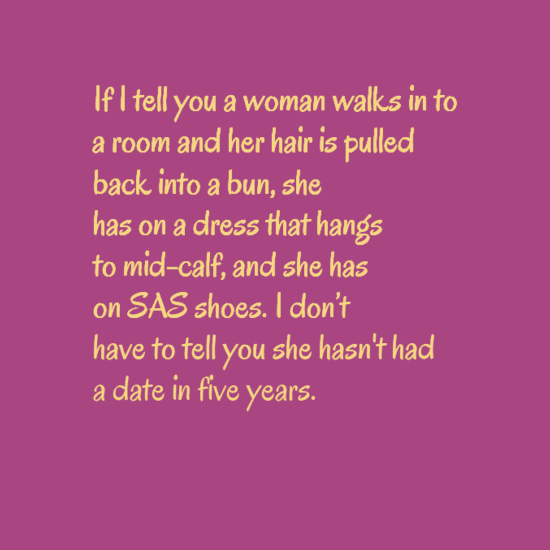
Here’s an illustration of tags I like to use in my writing classes. If I tell you a woman walks in to a room and her hair is pulled back into a bun, she has on a dress that hangs to mid-calf, and she has on SAS shoes. I don’t have to tell you she hasn’t had a date in five years. And notice you don’t have to know what SAS shoes are to get the picture they look like dark-colored versions of the shoes nurses wear. You made that up in your head, too.

If I wanted to surprise the reader, I could have all the men in the room vying for her attention. I could even put a beautiful blonde cheerleader type in the corner of the room that everyone is ignoring. Now the reader will want to know why the men pay attention to the SAS shoe gal and not the cheerleader, and the reader will start to make up reasons in their head. And I’ve already got a story brewing because I created conflict with my tags.

So you need tags. And if you don’t have them, even if you’ve gone into long detailed descriptions about your character’s appearance, your reader won’t remember. In fact, I avoid long, detailed descriptions about anything. I like to paint the picture with a few well-chosen strokes that are playing double and triple duty, like I did in my SAS shoe gal example. It’s fun and elegant to create a brief description that sets up potential conflict, and plays off the reader’s assumptions and stereotypes.

Motivation is another thing that will help your reader care about your characters. I recently was in an airport that had a special table in front of a bookstore which had multiple copies of two paperback versions of The Girl On The Train by Paula Hawkins with different covers, and then a hard back version. But no other books on the table. So I asked the bookseller why. And when he explained one paperback was the original version written by the author, and the other was the movie version of the book, and that both paperbacks would cost the same as the original hard-cover version, I bought the two paperbacks. Since I’ve done some writing for television, I wanted to compare the original to the movie version.

I had time on the plane so I started with the original paperback version, and I can tell you had it not been a New York Times best-seller, I would have put it down after about five pages, then deposited the book in the nearest paper recycling bin once I got off the plane. Because the girl on the train was someone I didn’t like at all. And it was because her motivation was nothing short of selfish and despicable, when there was any. Most of the time she was like a leaf blowing in the wind with no motivation whatsoever. It’s a principle of fiction that readers don’t like victims and this gal was definitely in victim mode.

My friend, and multiple Spur award-winning western author, Dusty Richards says your character needs to be motivated toward a goal and that you cannot remind the reader too many times of what that goal is.

I don’t know if I need to mention this, but the character’s main goal is always broken down into sub-goals. For example, let’s say there’s an old-west sheriff character on horseback. He can barely see in the moonlight. But he needs to make it over the next rise before sunrise to  the bad guy's camp to see if the thief he's after is in his bunk, and can be apprehended. The goal is to catch the thief, but the sub-goal is to make it over the next rise by sunup.

And, of course, there are obstacles to each goal, which is what keeps the reader engaged and the story moving. The character should have deeper motivation, usually produced by a painful past, that drives him as well. Like our cowboy sheriff hates thieves because a thief stole grandma’s fall harvest back when the character was a little tyke and grandma died that next winter.

The obstacles also need to be reasonable obstacles, not ones the character creates by their own stupidity. In the romance writing world, they have an acronym for this mistake in character development: characters who are TSTL (Too Stupid To Live). Readers are not interested in “I Love Lucy” plots where it’s all about manipulation and deception for some inane goal, like an elaborate deception to keep Ricky from finding out Lucy spent $5 more on groceries this week than the budget allows.

And The Girl On The Train so reminded me of “I Love Lucy,” only not as kind and gentle. It began with a good fifty pages of boring narrative about this woman who rides a commuter train back and forth past a row of houses every day, laced with detailed descriptions of the landscape, houses and the players, in between bouts of this woman drinking herself into a stupor at night. We finally get to something happening many chapters in, which is a murder. But even then, the main character was TSTL until nearly halfway through the book. What made it all worthwhile was the really satisfying ending, which of course, I had my doubts would actually happen in real life. But it was accomplished by a secondary character I had some respect for, who was helped by the main character, and that made it somewhat plausible.

I’m sure in a case like this, the author would argue people really behave the way she wrote them. And I agree. That does not mean, however, that I’m willing to pay money to put up with reading about it. (I did a little research and found out Paula Hawkins is British journalist, and I hear the Brits are accustomed to this take-a-while approach to getting into a story.) The only thing that kept me going was all the hoopla about the book, which I still think was rather unfounded. But I can see how the ending would strike a chord with women, who are the main readers of fiction. So I get it.

Now away from the book review and back to my subject, tags and motivation are the two things writers can utilize to make readers care. If you don’t have those two things, readers aren’t going to care. And they really want to care, so they’re disappointed when they can’t or don’t. Making the reader care is part of the job as a writer, but it’s not particularly hard work if you know what you’re doing. And I think it’s fun work – clever tags coupled with motivation that’s obvious and deeper motivation peeled back in layers. That’s the ticket.

Now, to be quite honest, we all stand on the shoulders of giants, and I’m no exception. I have several writers to thank for this information, including my romance writing friends, specifically Debbie Macomber and Jodi Thomas. Romance is very character driven, so those gals were a big help to me. And Dusty Richards, who is quite a character in his own right in his ten-gallon white hat and hands so big he has to buy special keyboards with extra wide keys to keep from “fat fingering” when he types his manuscripts.

I also want to thank the people who gave me feedback, because that consistent feedback created a tangible problem that I could then take to the “big boys.” But even with help, it took a while for me to wrap my head around this.

So if you’ve gotten the “I don’t care about these characters” feedback, then give your characters tags and motivation. If you think you already have, make changes anyway, and see if you can hit on a something that works for you. Because if you can make the reader care about your characters, that’ll keep them engaged in your story.

Bio: Linda Rohrbough has been writing since 1989, and has more than 5,000 articles and seven books to her credit, along with writing for television, and seven national awards for her fiction and non-fiction. An iPhone App of Linda’s popular “Pitch Your Book” workshop is available in the Apple iTunes store. Find her on Facebook as “Linda Rohrbough – Author” or visit her website: www.LindaRohrbough.com.

Wednesday, January 25, 2017

The Final Confession of Aaron Michael Ritchey

By: Aaron Michael Ritchey

I have a good sense of finality.

If you follow me on Facebook, you’ll notice that after most events, I post a picture of torn-down tables, empty rooms, or empty chairs. At comic cons, at writers conferences, it takes so much time to create the temporary marketplace and yet it can be torn down in minutes. Snap your fingers. Blink. And the event is over. All lost. Like tears in rain.

In the end, in the halls of our own selves, there will come a time when the books will be boxed up, the swag put away, and it will all be carted off to the van to be delivered to some impossible-to-understand destination. In the end, we all will be dead.

I have a confession to make. I’ve been lax on my Pikes Peak Blog posts. I was hitting the monthly deadlines for years on end (sometimes running late, er most of the time late), but in 2016 something has changed in my writing life.

I spent more time promoting than writing. The game has changed. I have five books out in the world, and if all goes well, by this time next year, I’ll have ten books, including three romances I’ve co-written with Andrea K. Stein, my partner in crime. By the end of 2017, ten books. That’s a lot. Howdy-do, that’s a lot.

One of Pikes Peak Writers dearest friends, Linda Rohrbough, now Linda Houser, gave me the rules of writing when I was brand-new back in March of 2006. She said the game changes at every stage, and the game for me has changed.

But I don’t want it to change. I want things to stay the same! I don’t want the vendors to tear down on Sunday night and I don’t wanna go home! Why can’t we always be at comic con?

Why must we die?

I don’t know.

But I do know that constant change is here to stay (yes, Rush lyric) and that I have to change with it. I have to accept the many deaths along the way.

So I have to step down from writing blog posts for Pikes Peak Writers.

The nice thing is, we have others, like the inimitable Jason Evans, who is there to replace me. And what great news for me, right? I’m writing books, I’m selling books, things are awesome, right? Right?

Nope. It’s too real. I want it all to be so much grander than it is. I want so much more dram, so much more amazing.

This is why I write fiction. Because in my books, I can make things how they should be, not how they are. In reality, I have to accept things as they are.

In a lot of ways, I don’t feel any different than I did when I didn’t have any books on Amazon. I feel despair, and hopelessness, and a keen sense I’ll never make it. And when I say make it, I mean how like J.K. Rowling made it. I wanna be Stephen flippin’ King or it doesn’t count.
Which is all such a recipe for disappointment. Even the real Stephen King isn’t the fictional Stephen King (yes, that’s a Dark Tower reference).

I have to practice being grateful. I have published books. I have a community of wonderful writers in Colorado whom I love. I don’t think there is a better state in the U.S. than Colorado for being a writer. We are lucky.

No, we are blessed. I’m blessed, that I’ve gotten to write for the Pikes Peak Writer’s blog for so many years. I’m blessed to be able to go to the conference every year and hang out with you wonderful people.

I’m just blessed.

And as long as I’m alive, I need to hold on to that feeling of gratitude.

Being an author isn’t an easy life, it never has been, but y’all make it so much easier.
Thank you, thank you, thank you.

I can never repay Pikes Peak for all it has given me over the years. The PPWC was the first writer organization that invited me to talk. You had me emcee the conference three years in a row. And dang, being asked to write for the blog was such an honor.

I love you guys.

And yeah, I’ll be stepping away, but I won’t be dying. Not yet. Not any time soon. I have books to write, dammit, before this party closes up, and I get to take that short walk home.


Aaron Michael Ritchey is the author of The Never Prayer, Long Live the Suicide King, and Elizabeth’s Midnight. His fourth novel, Dandelion Iron, the first book in The Juniper Wars series, is available now from Kevin J. Anderson’s WordFire Press. If you like the first one, Killdeer Winds, the second book in the series, just hit the streets. In 2015, his second novel won the “Building the Dream” award for best YA novel, and he spent the summer as the Artist in Residence for the Anythink Library. He lives in Colorado with his wife and two ancient goddesses of chaos posing as his daughters.

For more about him, his books, and how to overcome artistic angst, visit www.aaronmritchey.com. He’s on Facebook as Aaron Michael Ritchey.

Wednesday, January 18, 2017

The Business of Writing: Moving into Success Mode

Editor's Note: Please welcome Linda Rohrbough back to the blog. It's so wonderful to have her contributing again, and what a timely subject.

By: Linda Rohrbough

I recently listened to several new writers, (and by new, I mean pre-published) talk about the struggles they were going through. They were polite and respectful, but my condensed version of their monologue was “what you said didn’t work.” Meaning they didn’t sell their work even though they followed my plan, got in front of agents, and got a “send it.”

Discouraged was putting it mildly. They had a throw-up-your-hands, what’s-a-body-to-do attitude. They did admit they felt like they had won the lotto when they executed my advice and got a send it (after using my pitching formula). But once they got turned down, the publishing world became all gray and gloomy again for them.

I know no one wants to hear this, but there’s a term for this mode. It’s called victim.
Here’s the truth. There are people like me who cheer others on, and I’m happy to do it. Giving you formulas and keys to help you move toward your goals is part of who I am.

But folks, bestselling authors are not order-takers. If you’re waiting for someone to tell you what to do and how to do it, then what happens when you hit an obstacle you’ve never seen before? (You may hit an obstacle no one has seen before, or at least one no one will admit to seeing before.) Part of the reason bestselling authors get paid so well is they are risk-takers. They are willing to get out there and fail, then get up again and try. 

They are not victims.

Yes, life is unfair. Yes, ouch, it hurts when you get a "no thanks." Or the same advice, again. (Which, by the way, you need to listen to, especially if you keep hearing the same thing over and over. Repetition of the same comment from different people is a major clue to solving your problem.)

One of the principles I teach in my workshops is the game changes at each stage. If you’ve figured out how to get a send it from agents or editors, then you’ve moved into a new stage. And the game changes. It’s not over. It’s never over. You’re just at a new level.

I recently had a skin treatment for some scarring on my arms, which involves micro-injuries. Turns out micro-injuries produce healing and great results. After treatment with an electric “pen” that pokes my skin with nine tiny needles really, really fast, the injuries made stimulate my brain and nervous system to send healing resources. 

Does it hurt? You betcha. It hurts more hours later because they numb you during the process. It feels and looks like a bad sunburn, and peels like one, too. But the end result over time is firmer skin, reduced or eliminated scarring, and overall glowing health. There are several treatments involved that are six weeks apart, so this is not a fast process.

The fact that micro-injuries cause pain and it's not a fast process is a great metaphor for life, and it especially applies for life as an author. Any published author can tell you the micro-injuries are many along the way. And some injuries are not so micro. They limit the time they spend in “poor me” victim mode and instead find a way to use the stuff that hurts to move themselves forward. If you can roll with the micro-injuries, they can be healing for you and strengthen you as an author. The key is letting the injuries produce the results.

My goal with this article is to help you set your expectations, see these events as stepping stones, so you can be successful.

So, my pre-published friends, and my published friends, consider an attitude adjustment. Because, in reality, our ultimate choice in life, no matter what happens, is to choose our attitude. Success requires it, and that’s how you enter success mode.

Bio: Linda Rohrbough has been writing since 1989, and has more than 5,000 articles and seven books to her credit, along with writing for television, and seven national awards for her fiction and non-fiction. An iPhone App of Linda’s popular “Pitch Your Book” workshop is available in the Apple iTunes store. Find her on Facebook as "Linda Rohrbough - Author" or visit her website: www.LindaRohrbough.com.