By Linda Rohrbough
After a while in this business, the lingo starts to sound very much the same. However, I just found an idea that’s new to me that I think is quite useful. It’s plotting a book from a central point where the main character has a realization about themselves, then working backward and forward from that point.
I wish I could say I came up with this one. But I came across it in a Kindle ebook by James Scott Bell called Write Your Novel From the Middle. I’ve met Jim a couple of times at conferences we both attend, although I don’t know him well. (He does have one of my clocks.) Anyway, I’ve found his work on plotting useful in the past. Back when the world was young, he wrote Plot & Structure, one title in a series of how-to books on novel writing published by Writer’s Digest. I collected the entire series. I’ve used, with his permission, some of his ideas and graphs in my Writer’s Toolbox workshop.
To get to the point, here’s my graphical version of Jim’s start-from-the-middle method of plotting. Jim calls this the “Golden Triangle".
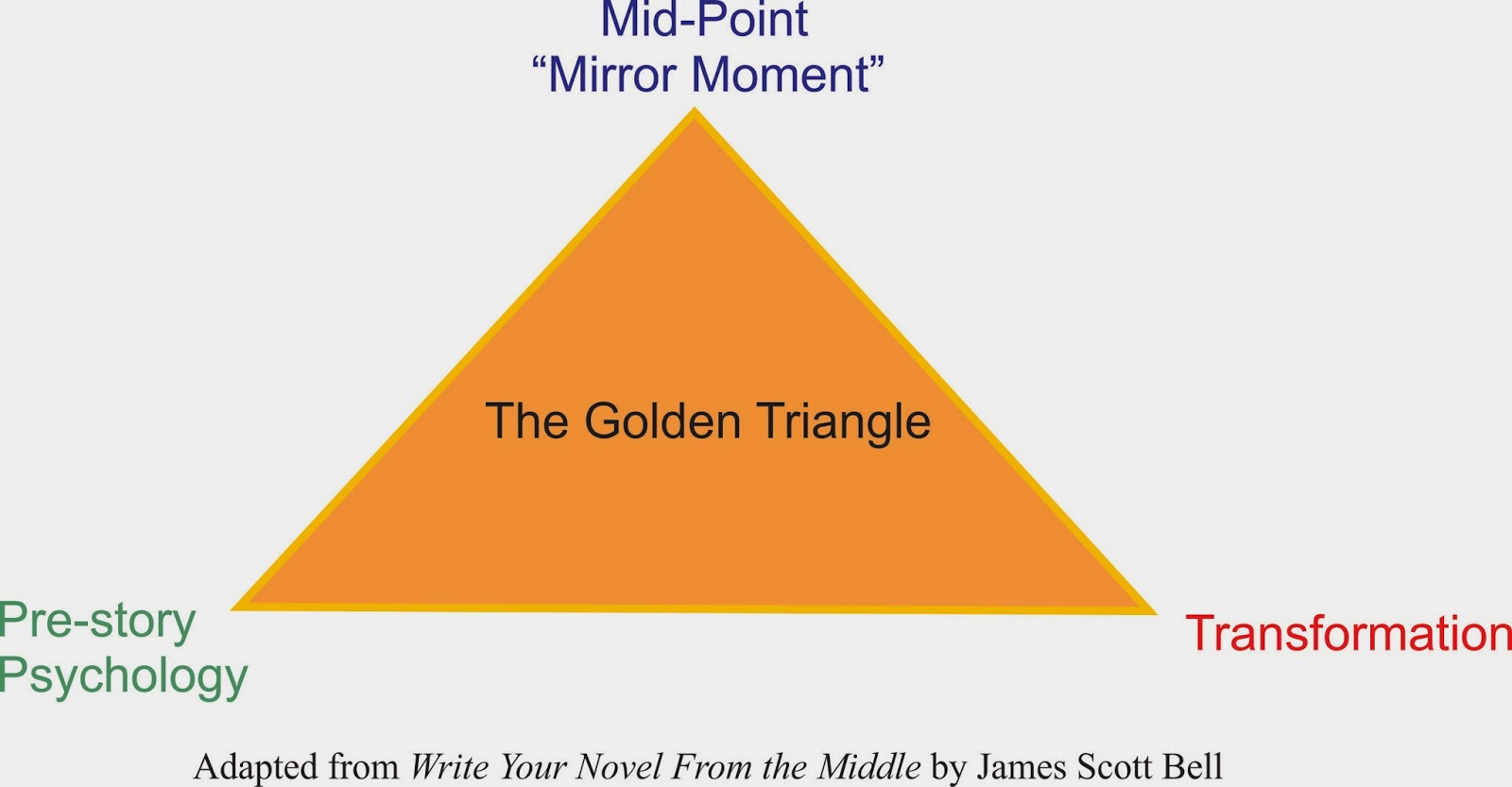
To start with the middle, you work first on the realization the character is going attain that drives their change in the story. Jim calls this the “Mirror Moment". This is the point in the story where your character takes a hard look at himself and his situation. Jim offers a number of examples from popular movies, although I’m not sure I agree with him on every “Mirror Moment". I think some movies have more than one of these for the main character.
But the concept is a strong one and one that I think is going to help me write.
The point is, once you figure out the Mid-Point, from there you decide the character’s mindset before all this starts, or their ordinary world, which Jim calls the “Pre-story Psychology". And then you look forward to the end where they actually make the change or “Transformation". Once you’ve done this work, your structure is a triangle and the mid-point is the pinnacle. This method not only gets you thinking about what your story is about, which is critical, but it also insures you’re looking at both the beginning and the end, which should tie together in meaningful ways.
As an aside, I’m someone who likes to write an ending in a way that a reader can’t just flip to the back of the book and see what happens. I want my endings to only make sense if you’ve been along for the entire ride. I think this method will help me achieve that goal faster and more efficiently.
I found Jim’s idea to be a fresh one and a great way to begin work on a novel. He includes a number of other little gems in this Amazon ebook in the form of structural devices that he says should be in every good story. Some I’d heard before, but some were new. And it’s not a long read so you can whip through it in an hour or two, though I spent a couple more hours making notes to add to a plotting structure template for novels. I found it well worth my time for the price, which is less than the cost of a latte at Starbucks.
He claims this method will work no matter what kind of writer you are, whether you’re a “pantser” meaning you just sit down and start writing, a plotter who likes to have forty scenes planned before the writing begins, or someone in between. And he provides a concrete how-to strategy to use this method for each of the writing types he identifies.
Jim also claims this will work for every genre, whether the story is literary or action-packed drama. I think he’s right. It’s certainly helped me get my arms around my work in progress. I’d love to know what you think.
PS: I wrote this assuming I was preaching to the choir. So if you're new to fiction writing and I lost you with this piece, not to worry. Just ask around. We all started somewhere and helping each other is what a writer's group is for.
About the Author: Linda Rohrbough has been writing since 1989, and has more than 5,000 articles and seven books to her credit along with national awards for her fiction and non-fiction. New York Times #1 bestselling author Debbie Macomber said about Linda’s new novel: "This is fast-paced, thrilling, edge-of-the-seat reading. The Prophetess One: At Risk had me flipping the pages and holding my breath." The Prophetess One: At Risk has garnered three national awards: the 2012 International Book Award, the 2011 Global eBook Award, and the 2011 Millennium Star Publishing Award. An iPhone App of her popular “Pitch Your Book” workshop is available in the Apple iTunes store. Visit her website: www.LindaRohrbough.com.
Showing posts with label plotting methods. Show all posts
Monday, September 8, 2014
Wednesday, November 21, 2012
Pick a Flavor: Three Ways to Plot Your Novel
By Debbie Maxwell Allen
Just as each of us lean toward a
particular flavor of ice cream (or none at all), so it is with plotting our
novels. You may just write freely, with no forethought, or develop pages of
outlines. Today, we'll look at three ways to plot a novel. You just might hit
on the perfect method.
Index
Cards. The old
standby is still going strong. This is probably the most popular method of
plotting. Whether you use colored cards or plain white, they can be shifted
around and added to until the plot is just right. I researched a few writers
who do a great job of explaining how they plot with index cards.
Author and teacher Holly Lisle takes
you step-by-step through Notecarding:
Plotting Under Pressure.
With her system, you don't even have to have an idea of what's going to happen
in your story. Also from Holly Lisle: a Plot Mini-Course sent to
you via email.
Author Marilyn Byerly uses index
cards and a more character-driven approach to come up with a great plot. Once
you know your characters well, inventing conflict for them is easy. Check out Using Index Cards to Plot a Novel.
Writer Phoebe A. Durand posts on A
Guide to Creating Changeable Novel Outlines. If you have small children who
like to shuffle your cards, or worry the wind will scatter them, don't worry.
You can use the virtual index cards in the free trial of Scrivener, a great writing program.
Sticky
Notes. These little
squares have a lot going for them. They're bright and colorful, and they won't
get mixed up if a draft blows through. Here are a few ways to make use of them.
Author Sara Cypher uses sticky notes
to plan around a plot arc and a theme at the same time. Her method is very
visual, and I plan to try her How
to Plot a Novel
soon.
Farrah Rochon, with Novel Spaces,
starts with making notes on "what has to happen" and "possible
scenes". She then makes a poster with a story arc and uses different
colors to keep track of characters. Check out the photos in How I Plot a Novel.
And Holly Bodger has an ingenious
method for keeping track of your main plot and
your subplots, so you won't leave any loose threads in Creating a Plot Graph for Your Novel.
Virtual
Plotting. Besides
the virtual index cards in the Scrivener Software, there are several programs
that allow writers to visually map all their ideas for plot and character right
on the computer. This is perfect for writers without a lot of space to spread
out, or who want to carry their ideas along with them.
Author Simon Haynes uses FreeMind
software (a free download) to plan his novels. Using screenshots, he takes you
through the steps he uses to plot
his novel.
John Barnett also uses
FreeMind software, and has created a YouTube
video to take
writers step-by-step through his plotting method.
Or, you can try outlining like
author Janet Evanovich, who describes her method as
"the easy way".
If you need a few more tips,
especially for NaNoWriMo, check out Jennifer Blanchard's Tools to Help You Plot Your NaNoWriMo
Novel. Great
info.
You might also be interested in free
resources from the Plot Whisperer, a free course in 20 Master Plots, or free plot tools from Save the Cat. And a popular method for
NaNoWriMo's is Rubik's Cube Plotting in 9 Easy Steps.
So
how do you plot your novel? Let us
know in the comments.
Debbie Maxwell Allen writes young adult historical fantasy
in the Rocky Mountains. She blogs about free resources for writers at http://writingwhilethericeboils.blogspot.com/.
Subscribe to:
Posts (Atom)


