Wednesday, February 15, 2017

The Business of Writing: Characters: Make the Reader Care

By: Linda Rohrbough

One of the things I heard about my work when I first started writing fiction was readers cared about my plot, but they didn’t care about the characters I’d created. So my question was, how do you create characters readers care about?

I’d done my best up until that point to create the characters I saw in my head, so I was clueless as to how to make readers care about these people who were so real to me. But the answer is actually quite simple.

Tags.

Motivation.
Let’s take tags first. Tags is the term in fiction writing given to character traits the reader can “see.” I learned them when I had three walk-on characters all dressed the same in a prison environment, who readers told me they couldn’t tell apart. And it got confusing for my readers. So another writer said give them tags, short but specific physical characteristics that are different for each one. A big space between a character’s front teeth, big hair, rhinestone glasses, a limp, a mannerism like rubbing their eyes a lot, and so on. So I gave each of those three walk-on characters, a unique tag. And it worked.

Watch people and you’ll see all kinds of tags you can make use of in your fiction. For example, one of the cheapest tricks in the book is to give a character a cold or an allergy– especially a walk on character. The writer has this character sneezing on others, or wiping their nose, or doing something related to having a cold or an allergy, and that sticks in the reader’s mind. Any time a character comes on to the “set” with cold or allergy symptoms, the reader will assume it’s the same character.

The classic example of this from my TV youth was Columbo. The character played by Peter Falk was always in a wrinkled beige trench coat carrying a cigar he never smoked with one eye askew. And he was kind of clumsy physically and socially. But he was smart and people always underestimated him. We loved that. And we remembered him. If you recall, no one else on the show was dressed like him or behaved like him.

I am constantly looking for fresh tags I can use in my writing when I watch people around me. I started dancing as a counter to sitting around writing all the time. Dancers are a great source for tags, especially in couple’s dancing. For example, there’s the guy with the plastic black framed glasses that are too big for his face that he constantly pokes back into place with his forefinger. And he wears big black shoes that look clunky, but he’s cut and glued a chamois to the soles, so he can glide on the dance floor in those shoes. And it turns out he used to be a dance instructor, so he’s actually a pretty good dancer. And he’s almost always in a short-sleeved collared sports shirt that’s some shade of teal. See, you’re already involved with this guy. I didn’t tell you his name or how tall he is or how old but you’ve already got a picture of him in your head.

Notice I didn’t have to give a lot of details. Just a few, and the reader will fill in the blanks. In fact, that’s one of the things I don’t like about television and movies, especially if they are remaking a book. I prefer the pictures I have in my head of the characters to what the producer came up with.

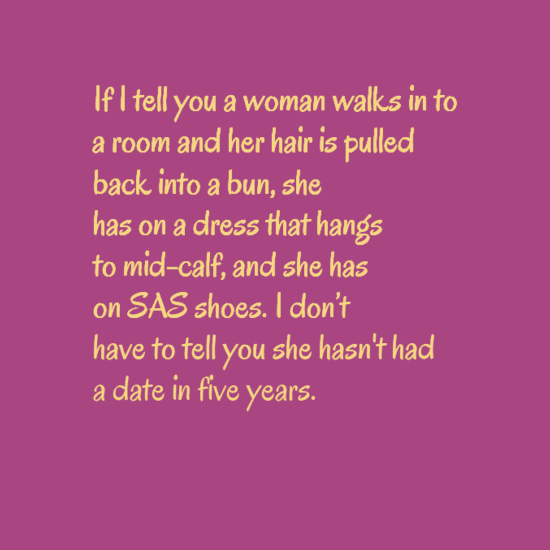
Here’s an illustration of tags I like to use in my writing classes. If I tell you a woman walks in to a room and her hair is pulled back into a bun, she has on a dress that hangs to mid-calf, and she has on SAS shoes. I don’t have to tell you she hasn’t had a date in five years. And notice you don’t have to know what SAS shoes are to get the picture they look like dark-colored versions of the shoes nurses wear. You made that up in your head, too.

If I wanted to surprise the reader, I could have all the men in the room vying for her attention. I could even put a beautiful blonde cheerleader type in the corner of the room that everyone is ignoring. Now the reader will want to know why the men pay attention to the SAS shoe gal and not the cheerleader, and the reader will start to make up reasons in their head. And I’ve already got a story brewing because I created conflict with my tags.

So you need tags. And if you don’t have them, even if you’ve gone into long detailed descriptions about your character’s appearance, your reader won’t remember. In fact, I avoid long, detailed descriptions about anything. I like to paint the picture with a few well-chosen strokes that are playing double and triple duty, like I did in my SAS shoe gal example. It’s fun and elegant to create a brief description that sets up potential conflict, and plays off the reader’s assumptions and stereotypes.

Motivation is another thing that will help your reader care about your characters. I recently was in an airport that had a special table in front of a bookstore which had multiple copies of two paperback versions of The Girl On The Train by Paula Hawkins with different covers, and then a hard back version. But no other books on the table. So I asked the bookseller why. And when he explained one paperback was the original version written by the author, and the other was the movie version of the book, and that both paperbacks would cost the same as the original hard-cover version, I bought the two paperbacks. Since I’ve done some writing for television, I wanted to compare the original to the movie version.

I had time on the plane so I started with the original paperback version, and I can tell you had it not been a New York Times best-seller, I would have put it down after about five pages, then deposited the book in the nearest paper recycling bin once I got off the plane. Because the girl on the train was someone I didn’t like at all. And it was because her motivation was nothing short of selfish and despicable, when there was any. Most of the time she was like a leaf blowing in the wind with no motivation whatsoever. It’s a principle of fiction that readers don’t like victims and this gal was definitely in victim mode.

My friend, and multiple Spur award-winning western author, Dusty Richards says your character needs to be motivated toward a goal and that you cannot remind the reader too many times of what that goal is.

I don’t know if I need to mention this, but the character’s main goal is always broken down into sub-goals. For example, let’s say there’s an old-west sheriff character on horseback. He can barely see in the moonlight. But he needs to make it over the next rise before sunrise to  the bad guy's camp to see if the thief he's after is in his bunk, and can be apprehended. The goal is to catch the thief, but the sub-goal is to make it over the next rise by sunup.

And, of course, there are obstacles to each goal, which is what keeps the reader engaged and the story moving. The character should have deeper motivation, usually produced by a painful past, that drives him as well. Like our cowboy sheriff hates thieves because a thief stole grandma’s fall harvest back when the character was a little tyke and grandma died that next winter.

The obstacles also need to be reasonable obstacles, not ones the character creates by their own stupidity. In the romance writing world, they have an acronym for this mistake in character development: characters who are TSTL (Too Stupid To Live). Readers are not interested in “I Love Lucy” plots where it’s all about manipulation and deception for some inane goal, like an elaborate deception to keep Ricky from finding out Lucy spent $5 more on groceries this week than the budget allows.

And The Girl On The Train so reminded me of “I Love Lucy,” only not as kind and gentle. It began with a good fifty pages of boring narrative about this woman who rides a commuter train back and forth past a row of houses every day, laced with detailed descriptions of the landscape, houses and the players, in between bouts of this woman drinking herself into a stupor at night. We finally get to something happening many chapters in, which is a murder. But even then, the main character was TSTL until nearly halfway through the book. What made it all worthwhile was the really satisfying ending, which of course, I had my doubts would actually happen in real life. But it was accomplished by a secondary character I had some respect for, who was helped by the main character, and that made it somewhat plausible.

I’m sure in a case like this, the author would argue people really behave the way she wrote them. And I agree. That does not mean, however, that I’m willing to pay money to put up with reading about it. (I did a little research and found out Paula Hawkins is British journalist, and I hear the Brits are accustomed to this take-a-while approach to getting into a story.) The only thing that kept me going was all the hoopla about the book, which I still think was rather unfounded. But I can see how the ending would strike a chord with women, who are the main readers of fiction. So I get it.

Now away from the book review and back to my subject, tags and motivation are the two things writers can utilize to make readers care. If you don’t have those two things, readers aren’t going to care. And they really want to care, so they’re disappointed when they can’t or don’t. Making the reader care is part of the job as a writer, but it’s not particularly hard work if you know what you’re doing. And I think it’s fun work – clever tags coupled with motivation that’s obvious and deeper motivation peeled back in layers. That’s the ticket.

Now, to be quite honest, we all stand on the shoulders of giants, and I’m no exception. I have several writers to thank for this information, including my romance writing friends, specifically Debbie Macomber and Jodi Thomas. Romance is very character driven, so those gals were a big help to me. And Dusty Richards, who is quite a character in his own right in his ten-gallon white hat and hands so big he has to buy special keyboards with extra wide keys to keep from “fat fingering” when he types his manuscripts.

I also want to thank the people who gave me feedback, because that consistent feedback created a tangible problem that I could then take to the “big boys.” But even with help, it took a while for me to wrap my head around this.

So if you’ve gotten the “I don’t care about these characters” feedback, then give your characters tags and motivation. If you think you already have, make changes anyway, and see if you can hit on a something that works for you. Because if you can make the reader care about your characters, that’ll keep them engaged in your story.

Bio: Linda Rohrbough has been writing since 1989, and has more than 5,000 articles and seven books to her credit, along with writing for television, and seven national awards for her fiction and non-fiction. An iPhone App of Linda’s popular “Pitch Your Book” workshop is available in the Apple iTunes store. Find her on Facebook as “Linda Rohrbough – Author” or visit her website: www.LindaRohrbough.com.

Monday, February 13, 2017

Meet Pikes Peak Writers Member Shannon Lawrence

By: Kathie Scrimgeour

Horrors! It is one of Shannon Lawrence’s favorite words. She has been writing horror for a long time and has a lot of fun with it. She also dabbles in fantasy and elsewhere. Shannon is a short story expert, and has two novels in the editing phase. There is a third novel in the works about killer squirrels. A horror comedy. As a short story author, she is constantly juggling rejections, acceptances, resubmissions, and releases. She shares some of her tools of the trade with us.

KATHIE SCRIMGEOUR:  Do you set daily, weekly, or monthly writing goals? If yes, what are they? What do you do to insure you meet these goals?

SHANNON LAWRENCE: I don't, because I've found I'm naturally a sprinter. I can go days without writing, then knock out a ton of progress in one day or a succession of days. Forcing it just stresses me out and lowers the quality of what I'm trying to write. I used to have some guilt over this, feeling like a failure, but I've finally realized I'm getting things done my way, and that's okay.

KATHIE SCRIMGEOUR:  If you have a completed manuscript/story/poem/flash have you submitted it yet? What have the results been? How do you get past the "No's"? What do your reject letters say? What best advice, or lessons learned, have you gotten from them?

SHANNON LAWRENCE: I'm not currently submitting any novels, but I have a bunch of short story submissions out right now. My goal is to have twenty out at one time, but, of course, I'd rather they get placed. I get more rejections than acceptances, but that's the world of short stories. I keep track of them on a spreadsheet and keep every rejection I get. The more I submit, the easier "no" gets, unless it's a publication I really wanted into or thought I had a good chance of getting into. Rejection letters are usually form letters due to the sheer number of rejections, but one thing I've collectively learned from rejections is not to hold back in your submissions. And if you have a strong opening, make sure the rest of the story follows.

KATHIE SCRIMGEOUR:  What does success mean to you?

SHANNON LAWRENCE: Success is always morphing for me. I kept saying "When I'm a multi-published author, I'll…" until a friend corrected and me and said, "You realize you ARE a multi-published author, right?" Originally, success to me was getting a novel published, and nothing else counted. But every step of the way is a success. I keep mini-goals along the way, such as having twenty stories on submission at once, getting a story into one of Ellen Datlow's anthologies, and more. Each one of these mini-goals met means another success. However, I would also like to be a published novelist, so that will be another type of success.

KATHIE SCRIMGEOUR:  Does success scare or motivate you?

SHANNON LAWRENCE: Both. I go through ups and downs. Sometimes the thought of having deadlines and having more expected from me is terrifying. As a short story author, I set my own pace. No one gets to require anything of me. But once I get into Novel World, there will be deadlines, possibly multi-book contracts where they have to be delivered by a specific time. And that will change the game. At the same time, I WANT to be there. It's just a scary concept.

KATHIE SCRIMGEOUR:  What do you do when procrastination is winning over writing?

SHANNON LAWRENCE: I try to figure out why. What is it that's distracting me. What do I need. I suffer from depression and anxiety, and those are most often the cause of my procrastination. Maybe I'm doubting my work. Or maybe it's just an off week for me, period, not just in writing, and I need to take a step back and focus on something else for a while.

KATHIE SCRIMGEOUR: Writing conferences, workshops, and critique groups are an important part of the new writer's experiences (and more experienced writers too!). How have they helped you?

SHANNON LAWRENCE: I'm not sure where I'd be if I hadn't found both Pikes Peak Pen Women and Pikes Peak Writers. Plus, my critique groups. Pikes Peak Pen Women was the first writer's group I joined. They were also the first ones to give me the opportunity to be a presenter, giving me the confidence to keep doing that and to branch out. It was far less scary having them reach out to me and say, "Hey, can you speak on this topic?" than to suck it up and submit a workshop proposal without ever having given a workshop. Pikes Peak Writers helped me join the writing community at large, making it a place of comfort instead of fear. They were the second ones to give me the opportunity to speak, which was at AuthorFest in Manitou Springs. And the workshops, both at conference and in the Write Brains, are what gave me the encouragement and knowledge I needed to go forward and improve my writing. As far as critique groups, my first in-person one taught me a lot about critique, and helped me learn what needed to be changed in my writing.

KATHIE SCRIMGEOUR:  How long have you been a member of Pikes Peak Writers?

SHANNON LAWRENCE: I believe I've been a member for five or six years now.

KATHIE SCRIMGEOUR:  Do you attend the events, and, if so, which ones are your favorites?

SHANNON LAWRENCE: I attend PPWC each year, and have held some manner of conference position every one of those years. There's a lot of energy to be soaked up at PPWC, and so many opportunities. I also ran the non-conference events, including Write Brains for about two years, so I'm taking a bit of a break from attending, but I still go to one occasionally. I've only attended one Open Critique, but it was a great program, and I go to Writer's Nights when I can. I would attend more of these if I just had more time, but I have to balance my evenings like I'm sure everyone does.

KATHIE SCRIMGEOUR:  Do you have any "self-help for writers" books that you use regularly? How do they help? Please share your list of your top 2 or 3.

SHANNON LAWRENCE: King's "On Writing" is an excellent craft book for authors, whether they write horror or something else. It's often cited as a favorite by other folks I've spoken with. I don't use any regularly, but a couple other good ones I've read are "The Art of Character," by David Corbett, "Writing with Emotion, Tension, & Conflict," by Cheryl St. John, and Stuart Horwitz's "Book Architecture" series.

KATHIE SCRIMGEOUR:  Does your reading influence your writing? How?

SHANNON LAWRENCE: I'm sure it does, but I don't know to what extent. I read a lot; I write a lot. I try to read in all different genres. There is no genre I can say I have not read in some way, shape, or form. I want to read all different types of stories and voices.

KATHIE SCRIMGEOUR:  If you met someone who was thinking about writing, what advice would you give them?

SHANNON LAWRENCE: I'd tell them to write. Don't think about starting, just write. Until you do, you're not a writer. Figure out what works for you and do it. Set a schedule or don't. Set goals or don't. Just write.

KATHIE SCRIMGEOUR:  What is one (or a few) of the most important lessons you have learned so far?

SHANNON LAWRENCE: Be resilient. Understand a rejection is not about you, and isn't even typically a judgment of your work. It's simply saying that particular story didn't jive with one particular editor or agent. Turn around and resubmit. Take in any and all feedback, mull it over, and then decide what you'll listen to and what you'll dismiss. If you don't believe what they said, you won't be true to your writing if you change it to what they want. So don't change something just because someone told you to. Change it because what they said struck a chord with you. Weather the lows so you can move forward and find the success you want for yourself.

KATHIE SCRIMGEOUR:  What expertise in your background do you draw on in your writing? (ie were you a photographer, chef, court reporter, FBI agent?)

SHANNON LAWRENCE: I wouldn't say I have job expertise I bring to my writing, but knowing kids has come into play, and personal experiences have informed my writing.

About the Author:  A fan of all things fantastical and frightening, Shannon Lawrence writes in her dungeon when her minions allow, often accompanied by her familiars. She writes primarily horror and fantasy. Her stories can be found in several anthologies and magazines, including Once Upon a Scream, The Literary Hatchet, and Dark Moon Digest. She serves on the board of Pikes Peak Writers as treasurer. When she's not writing or volunteering, she's hiking through the wilds of Colorado and photographing her magnificent surroundings. Though she often misses the ocean, the majestic and rugged Rockies are a sight she could never part with. Besides, in Colorado there's always a place to hide a body or birth a monster. What more could she ask for?


Social media pages:


Sunday, February 12, 2017

Quote of the Week and the Week to Come

“If people cannot write well, they cannot think well, and if they cannot think well, others will do their thinking for them.”  ~ George Orwell


Source: Wikipedia and Google

George Orwell is the pen name for Eric Arthur Blair (June 25, 1903-Jan. 21, 1950) He was an English novelist, essayist, journalist, and critic. His work is marked by lucid prose, awareness of social injustice, opposition to totalitarianism, and outspoken support of democratic socialism. He is perhaps best known for Nineteen Eighty-Four, often published as 1984, a dystopian novel published in 1949. 


This week on Writing from the Peak


Feb 13                Meet the Member Shannon Lawrence


Feb 15                The Business of Writing Linda Rohrbough


Feb 17                Sweet Success Celebrates Ann Myers

Friday, February 10, 2017

John Stith Author Signing on Hook on Books

By: Ann S. Hill 

On Saturday, February 11th, meet author John Stith who will be signing books at the downtown location of Hooked on Books, address 12 E. Bijou Street, 80903. 

Before attending the event, see an archived article recently published here on John’s many works. Next, get your own signed copy of at least one representative from John’s long list of published books.

Also check out a Facebook post on the signing: https://www.facebook.com/events/221286271663808/

John E. Stith’s novels include REDSHIFT RENDEZVOUS (Nebula Award nominee), MANHATTAN TRANSER (Hugo Award Honorable Mention), REUNION ON NEVEREND, and RECKONING INFINITY, among others.

Wednesday, February 8, 2017

Research in Historical Fiction--Do it First Blog 2

By: Jason Evans

I was really debating what I should write next. Hopefully, if you read my last blog, you worked on your logline. An extended elevator pitch that really focuses on what your book will be about. If you haven’t, read that blog first, go here

Hopefully, you written your logline, talked to people about it and received feedback. Hopefully, you’re excited about your story. I know you want to start writing. So before you do anything else, stop and take a breath.

Did you stop? Did you breathe? Good.

Now it’s time to put your big girl/boy pants on and do some research.

Yes. Research.

But Jason, you say, I want to write my book! I want to put down all these amazing scenes I have dancing in my head! I want to write about swashbuckling pirates, or daring World War II fighter pilots. I want to write about that rapscallion, Mr. Trumbly, and his, ahem, inappropriate affection for the innocent Lady Rothschild.

Take another breath!

Look, I have been there myself. I have had an idea burning me up inside. I have had a story literally hound me for twenty years before I got serious and wrote it. I am with you, friend. But can we be honest? I mean, brutally honest?

As a genre, readers of historical fiction can be quite zealous about historical facts. I’m not talking about major stuff we already know. I’m talking about the little stuff. The minutia. You know what I mean.
  1. Whether a historical figure was actually in a certain place at a certain period of time.
  2. The fibers used by weavers at the time of your book.
  3. The accuracy of military insignia for certain military units in particular military conflicts.
  4. How many stays a corset would have for a bosomy woman.

Do you get my point? We lovers of historical fiction will go to great lengths to pick out the inaccuracies in a published book or film. We love to nitpick.

I once had a dear friend explode into a murderous, trembling rage about the film Gladiator, with Russell Crowe. She told me the film was awful. Why? (Wait for it . . .)

The crowd pointed their thumbs down when they should have placed their thumbs up to let the gladiator in the arena know it was all right to kill his opponent. Yes. She was THAT serious about it. Never mind there is 80 years of gladiator films where the reverse occurs. (It would confuse the audience to show otherwise – even if it is historically accurate.) My friend was adamant.

THESE are some of the people who buy historical fiction. Don’t believe me? Go look at reviews for your favorite book of historical fiction. Read the 1 & 2 star reviews. Go ahead, read them. Most of them will have to do with minor historical inaccuracies.

So before you commit yourself to the time, effort and bloodletting of writing a book of historical fiction, please, do your research. It is THAT important. The last thing you want to do is write a wonderful book about a romance between Queen Elizabeth I of England and Philip II of Spain and find out they only met once, at Queen Mary I’s wedding.

Doing the research will not only prevent such pitfalls from happening to your book, it might inspire other ideas.

My first manuscript takes place during the last decade of Queen Elizabeth I rule of Ireland. I had studied the period in college, so I was pretty knowledgeable about the culture, the dress, even the food they ate. When I started to write my second manuscript, entitled Jerusalem’s Menace, I knew I would have to do a LOT more research. (The story takes place during the Crusades.)

As I was doing that research, I stumbled upon a historical figure that would be the perfect mastermind villain. This person was ruthless, cunning and sympathetic. The character was also a woman. I got giddy just thinking about her. If I had started writing first, I would have never discovered her. Doing your research first allows for your story to change according to the history, and not the other way around.

So I hope you’re excited about doing the research on your historical fiction. But, don’t get too excited! Please, please, please don’t go book your vacation to Florence because your book is about Cosimo De Medici. Don’t blow $300 on Amazon about World War I, or the Suffrage Movement. Start small. That way, you won’t feel bad if your ideal book doesn’t pan out.

My suggestion? Wikipedia.

I know. I know. Wikipedia gets a bad rap. But hear me out.

You’re not writing a graduate level research paper on Napoleonic France. You’re sniffing your way through the general stuff to see if your story has legs. Wikipedia is perfect for that.

You’re not researching some hot button issue like the 2016 Presidential Election, or whether climate change is real. Those articles get re-edited by people all the time. The articles themselves are political footballs. The page on English Regency Fashion? Not so much.

That Fashion of the English Regency page, for the most part, is written by passionate amateurs and professional historians. The chances that they are wrong about the broad arc of history is very small.

Wikipedia has a lovely footnote section with book and article titles. Sometimes, there are links to pages where the original source can be found. There are also wonderful historical paintings, diary excerpts, maps, diagrams and photos of what you’re looking for. You can get lost just looking at the photos and their origins. (I know I have.) Wikipedia not only lets you glean the basics for your book of fiction, it points you in the right direction when you’re ready to dive deep into a subject.

I hope I haven’t squashed your desire to write historical fiction. I hope I’ve made research more accessible to you. It isn’t that hard, but it can be tedious.

If you want to learn more, click this link here. It will take you to my site, where you’ll learn more about how to do research and what kind of research to do.

Next month we’ll talk about writing your book of historical fiction.

About the Author:  Jason Evans always wanted to be a writer, he just didn't know it. He grew up in Pasadena, California, in the 1980s where he watched way too much television, but was introduced to literature by his grandfather and his favorite middle school and high school teachers. He wasted his youth working at the So Cal Renaissance Faire (a dangerous place because it’s the gateway drug to other historical costumes,). In his leisure time he’s an educator, a writer, and a bon vivant. He is a graduate of UC Santa Barbara, with degrees in History & Renaissance Studies, a teaching credentials from CSU Los Angeles, as well as a graduate degree from the University of Colorado, Denver. He currently resides in Denver with his wife, the fetching Mrs. Evans, their three dogs and a mischievous cat who calls him his thrall. 

You can follow Jason on Twitter @evans_writer.
Like his Facebook page, Jason Henry Evans
Or, you can read his blog and sign-up for his mailing list at his website, jason-evans.net.


Monday, February 6, 2017

February 2017 Letter from the Editor

Did you read Writing from the Peak’s quote of the week on Sunday the 29th? I absolutely loved it. Award-winning Brazilian author Paulo Coelho penned the quote, “Impossible is just an opinion.” How many times a day do we hear the word, “can’t,” or “impossible.” I think there should be a test. How many times do we think, writing is hard, this book sucks, or I “can’t” do it?

I admit I’ve been stuck in this mire. I froze terribly over the last year and let life intervene. Not all bad, I promise you. I became a first-time grandmother to the adorable Ms. Norah Jane Bell. But we also listed our house, my husband retired, and my mom needed/needs additional help. The word “can’t” flooded my gray matter.

Like most people, I read craft books, read fellow authors' books (with pleasure), network and occasionally market my wares. However, none of it was bringing me joy. Writing Coach Deb McLeod has been the queen of inspiration. Her blogs, especially the last one on The Novel Writing Process on February 1, is solid gold. Read it.

But “can’t” still made me feel as though I was walking around in a cement overcoat. I honestly thought about quitting until a friend shared a book suggestion. It's called Deep Work, Rules for Focused Success in a Distracted World by Cal Newport.

Really? Another self-help book? But as I read, Deep Work wasn’t so much self-help as it was common sense.To do anything well, to grow, and to be successful, an individual must make intense concentration a priority. Imagine if social media had been around in Michelangelo's day. We might not ever have viewed the Sistine Chapel.

For the last few weeks, I’ve tested Newport’s theory. I’ve limited Facebook, and have only used Twitter sparingly to promote this blog. I have turned down social events and I have buried myself in my office. I've put my family on notice: I am finishing this book! The story I told you sucks? It’s good, and I’m excited again. 

Newport says distraction, while easy, can also be draining and lead to depression. He cites the same of social media. For me, social media is fun, which, in turn, makes it addictive. Further, giving in to distraction is the ultimate time-sink and surrounds us with a term he calls "residual thinking." Meaning when it's time to concentrate on that all-important project, we're still thinking about something we read on-line. 

OK, I miss all the time I spent on Facebook, but I've learned a lesson. Until I'm finished with my WIP, if I need an outlet, I’ll use this blog. After all, Writing from the Peak is all about writing, and are we ever ready for February! Guest blogger Michael Alvear joins us to discuss The Bulletproof Writer; Patrick Hester shares website advice for new writers; Jason Evans continues his series, Writing the Historical Novel; Kathie Scrimgeour presents another Meet the Member; J.T. Evans talks about successful query letters; Darby Karchut kicks off the first article for Conference; Stacy S. Jensen addresses the stalling topic of fear; Linda Rohrbough presents another Business of Writing post, this one dealing with character; and long-distance PPW member Jennifer Lovett returns to share marketing information as well as travels from South Korea! (How's that for jam-packed?) 

My critique partners decided we need a word for the year, and I chose the word focus. Not can’t, not impossible, but focus. By going deep, I’m loving writing again. And guess what I've discovered? Impossible is just an opinion.

Have a sensational February.


Donnell Ann Bell is the managing editor for Writing from the Peak, the coordinator for the monthly Open Critique held on the first Wednesday of every month, and one of Pikes Peak Writer's board members at largeShe is a best selling romantic suspense and mystery author. To learn more about her books, find her at www.donnellannbell.com

Sunday, February 5, 2017

Quote of the Week and the Week to Come

“Prowling about the rooms, sitting down, getting up, stirring the fire, looking out the window, teasing my hair, sitting down to write, writing nothing, writing something and tearing it up…” ~ Charles Dickens


Charles Dickens Wikipedia
www.biography.com


Charles Dickens, born on February 7, 1812 was a British novelist who is considered the greatest novelist of his time in Victorian England. He wrote such classics as Oliver TwistA Christmas CarolNicholas NicklebyDavid CopperfieldA Tale of Two Cities and Great Expectations. He died in 1870, leaving his final novel The Mystery of Edwin Drood, unfinished.


This week on Writing from the Peak


Feb 6            Letter from the Editor


Feb 8            Writing the Historical Novel Series cont. by Jason Evans


Feb 10          Sweet Success Celebrates John Stith

Friday, February 3, 2017

Pikes Peak Writers February Events

Write your Heart Out!

Feb 04, 2017 — 1:00 to 5:00 pm

Location: 5580 Tech Center Dr, Colorado Springs, CO 80919
What: Write Your Heart Out
Who:
Free with RSVP. Space is limited. Reserve your spot today by emailing: RSVP@pikespeakwriters.com – with first and last name of each person attending, and your phone number
When: February 4th, 2017, 1 – 5pm, doors open at 12:30
Where: Salon D – Marriott Colorado Springs – 5580 Tech Center Dr, Colorado Springs, CO 80919
More Information: On the fence about going to the Pikes Peak Writers Conference or just looking for some great interesting and educational programming? Join us at the 5th annual Write Your Heart Out, a free half-day Conference Teaser event. Six of our local authors presenting at the Pikes Peak Writers Conference in April will join us for an afternoon filled with fun and learning centered around the craft and business of writing. Take a sneak peek at our speakers and the topics they’ll be covering:
Laura DiSilverio – Using Setting to Reveal Character
JL Fields – The Nuts and Bolts of Non-Fiction Writing
Barbara Nickless – Say What? The Ins and Outs of Dialogue
M. H.  Boroson – Constructing the Great Action Scene
Lana Williams – 10 Tips to Keep the Middle Moving
KL Cooper – Today’s Marketing for Yesterday’s Author
Come join us for an incredible day to help further your writing career. We’ll have several drawings throughout the day.  Registrars will be on hand to help get you signed up for PPWC 2017.  Additionally, we’ll have the PPW Bookstore crew with books from our Keynote speakers, our Write Your Heart Out speakers, as well as popular and helpful books on the craft of writing.

Write Brain

Feb 21, 2017 — 6:30 pm to 8:30 pm

Location: Library 21c, 1175 Chapel Hills Dr. Colorado Springs, CO 80920
What:  Writing Gay Romance/Characters
Who:  Andrew Burns & Nicole Godfrey
When: February 21, 6:30-8:30 pm
Where: Venue@21c (upper floor, to the right if coming in the upper entrance) of Library 21c, 1175 Chapel Hills Dr. Colorado Springs, CO 80920

More Information: One of the most popular romance genres right now is Gay Romance, or as the folks in the genre like to call it, M/M romance. How does this differ from straight romance? That’s what we’ll take a look at. We’ll explore the popular tropes…it’s a lot more than just the hunky UPS guy falling in love with the lonely writer…Now there’s a story we might need to write! We’ll look at what it takes to make the characters look and feel authentic.

About the Presenter
s:
Andrew Burns has been writing since high school. His works have included short and long fiction. In the past few years, he’s taken major steps to improve his writing and has managed to get several books published under two pen names. He is currently a board member of Colorado Springs Fiction Writers Group. As A.M. Burns he has published several Urban Fantasy books with different publishers along with numerous short stories.
Nicole Godfrey is a writer who calls beautiful Colorado home, along with her fury children.  Her writing started with poetry, leading to her first publication at the age of twelve. She has three short stories published through Colorado Springs Fiction Writers Group; A Page Lost in An Uncommon Collection, and The Power of the Word in Remnants and Resolutions: Tales of Survival, and Trials of the Moon in Colorado State of Mind. Her first full length novel, Hoofbeats, released February 2016. Nicole actively participates in Amtgard, loves to play table-top RPG’s, and dabbles in artwork.

Writers Night

Feb 27, 2017 — 6:30 PM to 8:30 PM

Location: Kawa Coffee, 2427 N Union Blvd, Colorado Springs, CO 80909
Writers’ Night is two full hours of discussion, laughter, and fun with other local members of Pikes Peak Writers. Join host, Damon Smithwick, a longtime Pikes Peak Writers attendee, who took over as facilitator in January.
The direction of the meeting is decided by the participants and can include discussions about query letters, obtaining and working with an agent, writing conferences, or other specific points of the craft.  If nothing else, we talk about books!
Meetings are scheduled to start at 6:30 and run until about 8:30. These are drop-in meetings, so feel free to attend all or just part of them.


See you soon!

Wednesday, February 1, 2017

The Novel Writing Process

By: Deb McLeod

How do you write a novel?

If you’ve completed a novel you have a process you used that got you to that milestone. If you haven’t yet finished a novel, you, too, have a process you’re using to get you to the end result. If you want to write, but you aren’t, you’re working a process too. The process is not writing and the by-product fulfills the process. Make sense?

The product you get is created by the process you follow. 
  • Focus on improving the process and you’ll improve the product. 
  • Focus on improving the product and while you’re in your processes, trial and error ensues. Judgment rules and writer’s block flirts on the horizon. 
Writing a novel is a matter of focus. Where will you put your focus? On the product or the process?

While no two people write a novel the same way, or use the exact same processes, there are generalities that can be applied. Here are the four stages of novel writing as I see them:
  1. Idea stage
  2. Creation stage
  3. Revision stage
  4. Sharing stage
Each stage involves getting clear on the processes used to achieve the goal of the stage. Let’s say I’m in the Creation Stage and I’m focused on the end product – my really good novel I want to create.


Are the pages I produce during the creation phase going to be good enough to stay in my really good novel product? Probably not. These are first draft pages. And drafty ones at that. What happens when those creation pages are judged against the end product (my very good novel)? They fail. When they fail, I freeze. I go take a craft class. Or join a critique group. Or get writer’s block.

Turn that around and look at what happens when you give yourself permission to really be in the stage you’re in and focus on learning what works best for you within that stage.

If I’m in the creation stage, and I’m okay with the fact that everything I’m writing is teaching me what my book wants to be, then whatever I write is okay. Right? It’s all fodder for the gristmill. And you never know what connections you’re going to make if you give yourself permission to freewrite scenes that may or may not make the cut. What happens if you quick-write scenes that aren’t fleshed out but have the gist of what you want to say?

I’m a firm believer (because it holds true for me) in “How do I know what I mean until I see what I say?”

It has been said that the first response will be a cliché. And it’s been said that the first thoughts are thoughts without a filter. Which one are you? Do you gravitate toward the predictable? Or if you write fast enough that your internal editor can’t shut you down, are your scenes more vivid and memorable? I think you should know where you fall here. It’s good information for next time. Right?

Take a look at the stages that follow and see some of the definitions, goals and the skills that are necessary to use the stage to your advantage.
Idea Stage – freewriting, reading, mulling, talking, brainstorming, playing what if, creating an overview outline, digging into characters.
Goal = deciding on an idea with characters you think has legs. Legs simply means an idea that has the possibility of being interesting and will hold for the length of the novel.
Skills necessary to master: novel concepts, plot twists, outer conflict potential, character exploration and psychology, mythic characters.
Creation Stage – freewriting, using prompts, NaNoWriMo, word vomit.
Goal = accumulate enough material for your novel.
Skills necessary to master: Freewriting to an ever-changing timer, scene construction, type of conflict, using the senses, figurative language, metaphor, discipline to write daily, a place or container that is conducive to your writing, how to use prompts effectively (even the stupid ones).
Revision Stage – analyzing, model book(s), thematic discovery, detailed outlining for character arc, detailed outlining for scene arc, rewriting.
Goal = understanding what you wrote and how to shape into a viable product.
Skills necessary to master: story structure, following theme trails, outlining, deep character discovery, scene structure and conflict, rewriting for the reader.
Sharing Stage – critique group, beta readers, sending to agents, etc.
Goal = testing the waters with your almost finished product.
Skills necessary to master: letting go of your baby, cultivating a rhinoceros- thick skin, finding reader readers rather than writer readers, considering the possibility of self-publishing. Most important of all in this stage is: Start something new.
How do you learn the skills necessary? One: by doing them. Two: by taking a class. Three: by working with me. :)

Pieces not the whole
I learned the art of breaking big projects down into smaller bits when I worked as an accountant. The enormity of the (boring) job had the potential of making me want to call in sick. But the pieces gave me a sense of accomplishment. Like checking things off a list. Lo and behold, when I did the job long enough, I actually came to like it. The investigation piece was especially interesting, but even the day-to-day getting the numbers where they belonged was good, in the way cleaning a house can be good. You know? I focused on the individual pieces and came to like what I was doing. Essential for health and happiness, right?

But the skills I learned in those accounting jobs have served me greatly in writing novels and in teaching novel writing. My clients work the process and step away from judging the quality of the product too soon. They allow themselves the creative freedom to explore. They write better books, more true to their voice and their deepest feelings about the themes.

Best of all, focusing on the process gets the job done. And gets it done faster.

So narrow your focus, write every day, and master your career in steps.It just makes the whole thing achievable. And far more pleasant.