Showing posts with label creative coach. Show all posts

Wednesday, July 5, 2017

The Number One Problem Writers Face

By: Deb McLeod

This past year has been one of experimentation for me. I’ve started projects, shelved projects, or put them off until later. I’ve finished four novel drafts, and a few half-drafts. I designed and delivered a class on revision. And, I spent the past year working with marketing experts to determine if and how to bring my coaching business online. It’s been quite a year. 

Now I’m beginning to look at what was accomplished, what was not, and what continues to baffle me.

The Writer's #1 Problem
Working with the marketing experts has been particularly intriguing. One of the key ingredients necessary when you’re working on marketing your business is to discover what the #1 problem your clients have. Of course, if you can provide an answer to that #1 problem, well, you’re golden.

Even if potential clients don’t know fixing the #1 problem is what they need, the clients who need to find you will find you because you’ve articulated their biggest problem. And of course, when you provide a solution, well, it’s a win-win.

I’ve been coaching for more than seventeen years so I’ve spent a lot of time thinking about what a writer’s #1 problem might be. Over the years, I would uncover a problem, either in my client’s work, or in my own. It might be craft, it might be process, it might be accountability. Then I would design a class, design a way to be accountable, or document my process so I could teach it. All would be well for my clients for a bit until another problem surfaced. 

I never could get to the bottom of the problem pile though. What I offered helped, but it wasn’t the fix. 

For a long time I thought accountability would be the fix. I thought the problem was a lack of communal drive to get the work done. Creative competition is a great driving force. Creative support will get work done like nothing else. But after my year-long experiment hosting an accountability membership site, I can see that accountability is a surface portion of the real problem. That under accountability lies a bigger issue. 

After much thought, lots of questions, and comparing notes with other coaches and writing teachers, I now know what I feel like I knew all along. So simple to recognize when you’re looking at it the right way. 

The #1 problem writers face is a lack of inspiration. 


I want to say – well, duh!

But it feels great to be able to put that into words. And it feels strange too. You see, I never really thought I suffered from a lack of inspiration. My suffering always centered around time. Around too much life to live to take time out to write. Then there was a lack of knowledge about craft. My ideas were bigger than I knew how to write. Then there was lack of process. I had no clue for a long time how you got from the beginning to the end of writing a story. 

But I always wanted to write. I always saw myself writing. I always, always knew I would find a way. And I squirreled away time to write. I got up in the middle of the night. I wrote on my commute to work by dictating into a tape player. I wrote at lunch when I had to work and that kept me "cubically" sane. 

I was always inspired to write. Wasn’t I? 


Or were the issues that kept me from committing to writing in a real way (money, job, kid) manufactured by me because I was inspired to dabble? Not inspired to write? 

I’ll never know the answer to that because I’m inspired now and I will never go back. Life simply isn’t in Technicolor when I don’t write. 

The #1 Solution
So early in my marketing investigations, I never really considered that a lack of inspiration would be the #1 problem writer’s face. But what I do know is that it will continue to be a problem until writers find a way to make their writing a practice. Not a habit. A practice that they have to do to make their world feel right. 

By the way, a writing practice can be created. But the million dollar question is: can it be taught? How do you inspire someone to come along on the transformational journey that is a writing practice?  

I do not have the answer.  


Pom Pom Girl
At times my husband, John, calls me the Pom Pom Girl, or says your pom poms are showing again. Aside from the obvious jokes about that, what he means is that I’ve spent a lot of time on the sidelines of my family (and my clients), cheering everyone on. I’m the one who knows they can do it. I’m the one who sits with them until we find a solution. I’m the one ready with the smile, with the words of encouragement. I love pooling resources and brainstorming and finding a way, no matter what the issue is. I’m the Pom Pom Girl and life is great!

Until I’m not, because a more thankless job could not possibly be found, right??? And where’s the Pom Pom Girl for me??? Well, my clients have been my Pom Pom Girls. Over the years sharing success, sharing dreams, sharing solutions and doing it together has been what’s inspired me. 

And I’ve crossed a line that became very evident not long ago. Writing for me is not a habit. It’s a practice. 

Here’s how I can tell
I used to do vacations differently. In the old days, vacation for me meant bringing my writing because that was the treat I got to do when I stepped out of my day-to-day life. I have so many journal entries of short stories written as we drove in the car or flew toward the beach. I would get so many ideas when I was on vacation. I have pages of observations about where we were and the people we met. Invaluable details about place. 

But not long ago we went to San Diego. We were at a wonderful hotel on the water for a full seven days. John was in a conference every day from early till late. I planned to get a ton of writing done on my vacation. I brought the supplies. I had the time. I found the place(s) to write. I found the coffee. I had the sun. 

It was the hardest writing I’ve ever done. Because I WAS ON VACATION! Writing had become the day-to-day and vacation-me wanted a break. What a fantastic turnaround!


So now, when I go on vacation, I bring my work, but not my expectations. I’ve earned the vacation from the writing just like anyone who takes a vacation from their job. Though I still bring it and I still work most every day. But not as hard and not as fiercely as I used to when writing was still a “treat.” 

I’m on the other side of that. And I’d love to know how to help other writers get on the other side of their writing too. But that takes me back to the question of whether or not you can inspire someone to take the writing journey.

After much thinking, what I’ve discovered is that the solution to prodding writers to exercise their voice is not a-one-size-fits-all solution. Writers need different things to inspire themselves so they will find a place for their work in their day-to-day world. They need different things depending upon where they are in their project. They need different solutions depending upon where they are in their life and how writing fits into it and whether their families are supportive, tolerant, or outright scornful. Everyone needs a different solution.

So I don’t have any answers, but at least now I know where the focus needs to be for each and every writer. In order to transform your world from where it is to a writing world, the answer is to discover, develop, and honor what inspires you.

So I’m asking. Really. Spend some time with yourself and see if you can figure out what inspires you. Ask yourself these questions:

  
When you’re writing, and I don’t mean slogging to a deadline, or earning your green check mark on my accountability site, what is it that gets you to step out of your day-to-day life to write? 
  • Is it the story you’re working on that you’re excited about? If it is, when you’re excited about your story, try to say when in the project you typically get excited. At the beginning? Or further in when the story starts to come together and all you have to do is write it? Does revision inspire you? (NOT!)
  • Is it when you learn a new piece of craft and try it?
  • Is it after you’ve attended one of my Spilling Ink! Classes and learned all the ways the scene you thought was flat actually contains your own brand of brilliance?
  • Is it when you go on vacation? 
When your life is said and done if you knew what inspired you and you kept that in the forefront of your world... seems like that would be the difference in whether you made the transformation or you did not.

I’m always here to help if you need me – my pom poms are at the ready. 

But, really, inspiration? That one’s on you. 


About the Author: Deb McLeod, MFA, practices novel research immersion. For her novel, The Train to Pescara, Deb journeyed to Sardinia to study ancient goddess worship and spent time in the Abruzzi village her great-grandparents left in 1905. Her metaphysical knowledge for the Angel Thriller, The Julia Set, culminates from four years of studying and teaching meditation, clairvoyance and chakra healing. For over fourteen years, Deb McLeod has been a creative writing coach helping other writers to embrace their passion and get their words on the page. For more, see www.debmcleod.com.


Wednesday, May 4, 2016

Writing Warriors

Deb McLeod Creative Writing Coach - Be a Writing Warrior
By: Deb McLeod

Are you like most writers: someone in school complimented your writing? Said you might have what it takes? Or you won an English award in school? Published a short story, poem, or article when you were young? Did you have one of those wonderful teachers who stirred the pride and created the possibility that you could be someone with your words?

That’s what happened to me and every one of my clients. At some point, at a young age, someone saw our potential and encouraged us. After high school, or college, most of the writers I know stopped writing. Life started and who had time for the long hours? Or for figuring out how to craft a good story? Or time to put in as an apprentice before the writing improved.

But the seed had been planted.

Then, sometime later, it’s a different time and a different reason for everyone I know, something stirred the memory of that pride. Something woke up the possibility once again that maybe you have something to share. Perhaps, like most of us, you picked up a pen again, or took a class. And you started writing.

So what happened after that? No one really prepares you for the journey. Not how long it will take. Not the challenge and all the aspects that need to be mastered. Not for how many words you really have to write before you find your voice.

But somehow, if the original words were strong enough, if they give you something to hold onto as you learn the craft, develop the discipline, and deal with the business side of writing, you’ll make it.


What you need when it’s finally time to get serious

Daily boundaries

The first step to a career as an author is the ability to set daily boundaries around your writing time. Writing is a solitary venture. Even if you have a weekly writing group, or a daily one like I do, you must still learn how to set fairly impenetrable walls around your writing time, every single day.

Boundaries that are:
  • Consistent 
  • Designed to train yourself
  • And designed to train the rest of the world
It’s not easy to close the door on everything that’s happening and withdraw into your own little world. But it’s necessary if you want to produce books. If you are consistent in putting boundaries around your writing time, you will get used to writing daily and you’ll miss it when you don’t. You may become downright cranky when you don’t get your writing time in. Best of all you’ll be working from the energy of accomplishment. Not from the ‘should’ place.

I get up before my alarm most days, around 4:30 a.m. to write, because I’m excited to spend time in my fictional world. Excited to get done first what’s the most important to me, before the day starts. I’m not the only one I know who gets up before the alarm either. Many of my clients feel just like I do.

You don’t have to get up early or before your alarm. But you do have to carve out a daily time that is dedicated to your writing. Thirty minutes a day is better than a few hours on the weekend. Writing is a muscle. Exercise it religiously.

You Need Support but you might not always have it.
  • Family
  • Other writers
  • The World
I, myself, have a lot of support within my family, now. But I know lots of writers who never had it. Some whose writing is considered a hobby that takes them away from the real things in life. When your family doesn’t support your ‘creative hobby’ it can be devastating. But it cannot define you.

My first husband was not supportive of my writing. Rather, let’s say he didn’t have much confidence that I could be someone who would become a writer. And I bought into that for a while, myself. Thinking I didn’t have what it takes. Or that I had to get a degree in creative writing in order to be a writer. My family of origin sort of collectively shrugged and said: whatever makes you happy. While that was great – it wasn’t like someone cheerleading. I have a cheerleader in my second husband, John. And that is everything. When someone believes in you.

But, not everyone will have that. In the beginning. Some writers will have to find other ways to get support and put their boundaries in place anyway. It sucks not to have a cheerleader in your family or to have family that dismisses your dreams. It truly does. But the work has to be done anyway.

Other writers will support you, they are generally going through similar issues themselves. So finding a tribe is very important to succeeding. Look wide and find the right tribe. They can keep you going, especially if your family doesn’t.

Getting the world’s support might take a while. The world is skeptical. So support from the world is a little harder to manufacture. The trick here is twofold. Write the best damn book you can, so take a class, find a mentor, hire a coach and learn how to write work you can be proud of. Then, finish. Finish your book, publish it with a traditional publisher or publish it yourself, and call yourself an author. Cross that line with a well-written book, baby, and the chances of the world supporting you are much, much, greater.

Relationship with your inner critic

This is one of the biggies. And one that you will likely work on for your entire writing career. This is one of the major focuses of my coaching practice. How to turn your inner critic into a partner. And there are ways.
  • Habit 
  • Recognizing when your inner critic is present
  • Creating mutual respect 
  • Training your inner ear to hear the potential in your writing


I’ve covered the importance of the writing habit. But it’s not just in page production. Staking a claim to your time, getting serious about your art, tells you something about what you will tolerate and what you will not. Negative self-talk has no place in the production of pages.

An internal editor is necessary, but all too often the internal critic has taken over. At best the internal critic makes that first draft hell to get down or makes it almost impossible to carve out time for your writing. At worst the internal critic and self-doubt stop you cold.

Becoming conscious to your internal editor’s presence is vital to your well-being as a writer. One of the first exercises my clients do when they sign on to write their books with my guidance is to name their internal editor. Begin to separate that negative self-talking, know-it-all, from the creative and fragile part of themselves that needs to create. There’s a time for the editor to take over, but it’s not in the creation stage.

Recognizing that your internal editor has a place in your writing life and where that place exists is the first step toward mutual respect between the creator and the critic in you. Do whatever you have to do to define and tell your internal editor that if she/he/it doesn’t let you play and create without regard to the rules of grammar, the rules of writing craft, or any of the arbitrary writing rules she can throw at you, without her insults and her derision, then you won’t have anything for her to fix when it’s her turn to actually be an editor. This one is a deal breaker.

Ear training

In my classes we work on ear training. Both inner and outer ear training to hear the potential in your raw work. In small, supportive groups, we share raw work and help one another see the brilliance. This may not sound like much if you haven’t done it. But every single one of the writers that comes to me, every single one, is surprised about what we see in their work that they couldn’t see. The images, metaphors, themes, word choice, structure, craft we can see. So many of those pages would have been dismissed if we hadn’t been there to show them what was working.

We write together. We read raw work. We find the brilliance. Through that my writers find their voices.

It’s a completely different approach to writing and will allow you to find your voice within the story when you can switch from focusing on what isn’t working to learning to hear what is working. You know more than you think you do. Or should I say you know more than your inner critic thinks you do.

Change it up

This one is more of a tool than a necessity. But it works. There’s a wonderful energy that bursts through you and your writing when you change up your process. As soon as you’re super comfortable with the length of time you write, maybe the place you write, your rituals, and sometimes even the time you write, it’s time for a change.

Be bold and set a word count goal or a time count goal, or both. Track them. Get consistent. Then push the envelope. You’ll be amazed at what comes out your fingers when you change up the rut.

If you’re ready to get serious and you’re interested in finding out more about what you can do, drop me a line www.deb@debmcleod.com. I build writing warriors with community, craft, and positive feedback.

About the Author: Deb McLeod, MFA, practices novel research immersion. For her novel, The Train to Pescara, Deb journeyed to Sardinia to study ancient goddess worship and spent time in the Abruzzi village her great-grandparents left in 1905. Her metaphysical knowledge for the Angel Thriller, The Julia Set, culminates from four years of studying and teaching meditation, clairvoyance and chakra healing. For over fifteen years, Deb McLeod has been a creative writing coach helping other writers to embrace their passion and get their words on the page. For more, see www.debmcleod.com.

Wednesday, April 6, 2016

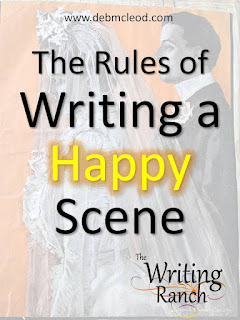
The Rules of Writing a Happy Scene

debmcleod.com
Shy Bride image courtesy of Renee at Flickr 
By: Deb McLeod

I have a sort of formula I use and teach for crafting scenes. It's general enough that what makes it onto the page isn’t predictable, but helps in prepping or revising the scene. My method is based on identifying the conflict in the scene.

Recently in a class I’m teaching about Show, Don’t Tell, I said it’s much harder to write a “happy scene” than one with conflict. Then, of course, I challenged my students to do just that – write a happy scene and focus on using show, don’t tell.

I believe readers read for conflict. For the movement of a character through a challenge as he tries to reach his goals. So what place do happy scenes have in the novel? They can be great for pacing, for a breather for the reader. They can set the stage, or up the ante for what’s to come, too.

In completing my assignment, one of my students was challenged with writing the happy scene. Her book has a character who’s weeks away from getting married to Mr. Perfect. He’s the guy she’s dreamed of, but in the story, Mr. Ex steps back into the picture. Her happy scene comes at the beginning of the character’s journey through the story. She and her fiancé are perfectly happy and content as the days tick by toward the wedding. So how to write this? How to show the stasis of the character before the journey presents itself?

Before I answer that specific question for her book, let me illustrate some of the "Rules of Happy Writing" for your novels.

Conflict

First and foremost, when you’re faced with a happy scene, ask yourself if it’s really necessary to the story or are you avoiding conflict on your character’s behalf? So many of my students struggle with this issue. Most are female, most were raised to be “nice.” Dragging characters you love through the mud of a real journey can be hard. So if you’re writing a happy scene, know whether it really serves the story or if it's simply the author avoiding conflict on the character's behalf.

Earning the Happy

I had a great teacher who occasionally would comment on my pages with “you haven’t earned this yet.” Usually her comment circled a passage that was intended to pluck the heartstrings of the reader. Usually the passage bordered on purple prose. It was the satisfaction that should come after a hard-earned battle for my character. But if I hadn’t put my character through the paces enough with the reader, I hadn’t earned the right to sentimentality.

You can get away with a bit of purple. You can twang the heartstrings, but you have to earn it. When you haven’t earned it yet, it’s usually because you, the author, are feeling it, but you haven’t gotten the reader to feel it. They’re not ready for the warm fuzzies. So how do you get them ready for it? Conflict.

When you’ve given the reader enough conflict or enough action, you can create a happy scene or a paragraph of purple. By then you’ve earned it. The reader will appreciate the breather. Their hearts will overflow with joy right along with your character. But you have to set it up.

But what if, as in my client’s story, the happy scene comes toward the beginning of the journey? What if that's the status quo you need to set up before your character launches into the story? There are ways you can structure this happy scene, e.g. frame it with two conflict scenes, make it flashback, and more. But I want to show you how to use happy to foreshadow unhappy.

Sickeningly Sweet

Once upon a time in college, a teacher challenged me to crawl inside a poem and write a creative nonfiction piece about it. It was an 18th century poem from the Romantic Period. I have no recollection of the title or who wrote it, but it was about a bride and her wedding. It was long and intricate, stanza after stanza of flowery language about a happy event. Gag me.

It was a poem I would normally read only on the surface and move on. But this one had survived the ages, so there must be something to it, right? The Romantic Period was the time where the individual over society began to have a presence in literature.

So when I read that poem closely, what I found was exactly like you find in “The Road Less Traveled” by Robert Frost, which everyone mistakes about being unique and different, when it’s really about crafting your perspective about the road you already took. This bride poem was about a bride in the days of arranged marriages. It showed her terror about being given to someone she didn’t know who would have absolute power over her for the rest of her life. All of it dressed up in the pomp and circumstance of a large and rich wedding.

As I studied the language, I began to look behind what was on the surface: a bride chattering about her wedding day. But she used words like “scratchy” for the lace at her neck. She was describing the dress with all its layers and petticoats as heavy. The strain of walking gracefully, curtsying gracefully under all that covering. Her disappearance inside the icon of the bride as time was creating a relentless march toward the big event. There was tension in the poem I hadn’t noticed at all until I read it more carefully. The poem was about a frightened young girl who had disappeared into the mask of the "bride."

When I read it closely, I could see that she was actually dreading what was about to happen within all the lovely excitement of preparing for her wedding. There was conflict between being the center of attention, but really being invisible as she took on the bride role. All the preparation was really a slight of hand to keep the bride from contemplating what’s happening to her; that the rest of her life as Mrs. X is unknown. So many bad things might be waiting on the horizon of an arranged wedding for political purposes. There were chinks in the picture you wouldn’t see if you simply took the poem and the character at face value.

So how does this help my student when it’s just one scene and not the whole? With a poem the whole is right there on the page, to read in one sitting while a scene is a building block.

Using Happy as a Building Block

And that’s the key right there for my student: recognizing that her happy scene is a building block to the future novel that will unfold for the reader. Take the premise of this story. A young woman is moving close to her wedding day with Mr. Perfect. When the Mr. Ex comes into the picture, he threatens to worm his way back into her heart. 

So I ask this: if the possibility for Mr. Ex to come back into her life exists at all, then we have to see those chinks in the perfection in the happy scene. Right? Because if it was perfect, Mr. Ex wouldn’t be able to get back in, would he?

So the key to writing this happy scene is in the subtle clues that will show all is not really perfect in this world. It’s not yet conscious to the bride that Mr. Perfect isn’t what she wants. She thinks she does. But have you ever had a relationship with someone with whom you did not fight? Isn’t there something missing? When the surface is perfection, isn’t there something imperfect lurking below? There should be in this story, for sure.


So how do you do that? The same way the poet did. Look at the verbs you’re using. Look at the modifiers that shape the nuance and the flavor of the scene. It’s off just a little. There’s foreshadowing in the language. Not foreshadowing a particular incident to come. You don’t want to do this heavy-handed (unless you do and then I say, go for it). But you want to add a shadow to the perfection.

A too-bright smile. A tiny misunderstanding. Maybe both reach for the last strawberry in their perfect brunch and then almost fight to be polite and let the other one have it. Who wins?

Does he insist and she picks it up and brings it to his lips in a sensual moment. He opens his mouth to bite while gazing into her eyes and a red drop drips onto the sleeve of her new ice-blue satin blouse. The spot which she notices and covers up a few times during the scene. The spot she’ll try to hide by turning the sleeve under her wrist, but that means the sleeve is now twisted and is slightly uncomfortable.

If you pick a few of these things, a perspicacious reader will get it. Most readers won’t, but that’s OK. You will be creating a tad of unrest that all is not well. It won’t be conscious to those non-perspicacious readers, but when Mr. Ex steps into the picture, and she is thrown off balance, it will seem inevitable, because those clues have been planted. When she does let Mr. Ex back in, the reader will say, I knew it wasn’t all that perfect. Of course, they knew. Because you'd planted those seeds in your happy scene.

About the Author: Deb McLeod, MFA, practices novel research immersion. For her novel, The Train to Pescara, Deb journeyed to Sardinia to study ancient goddess worship and spent time in the Abruzzi village her great-grandparents left in 1905. Her metaphysical knowledge for the Angel Thriller, The Julia Set, culminates from four years of studying and teaching meditation, clairvoyance and chakra healing. For over fifteen years, Deb McLeod has been a creative writing coach helping other writers to embrace their passion and get their words on the page. For more, see www.debmcleod.com.

Wednesday, March 2, 2016

Through Accountability Writers Write

Deb McLeod Group Accountability
The single best piece of advice a writer can get is to write. Every day.

But let’s face it, it’s hard to get to the chair, hard to carve out time from our busy lives, hard when we aren’t sure how to go about it, and when we haven’t written in a while. Yet as a writer there is nothing more satisfying than finishing. Starting is more fun, to be sure. But finishing is the only thing that will get us where we really want to be.

If you already have a habit of writing, that’s terrific. Keep at it. And, once in a while, refresh yourself by challenging that habit from time to time. I ask my freewriting clients to challenge their time limits. To stretch them so their scenes don’t all have the same arc. Or to shorten them and force the brain to go deeper, faster. Challenge your habits and see what a charge you can get from the new energy you’ll have.

For those of you who don’t write regularly, what stops you from making writing a habit?
  • Perfectionism
  • Lack of craft knowledge
  • The romance of the dream
  • Support
Perfectionism will kill your career before it starts. When I was a graphic designer producing creative work on demand and on a client’s schedule it helped me move into the ‘good enough’ space. When you’re on a client’s deadline you’ll let the piece go when the clock runs out. But how do you reproduce that motivation when you don’t have someone tapping their fingers just waiting for you to be finished? How do you manufacture goals for yourself?

Lots of beginning and intermediate writers don’t know how to achieve the effects they’re looking for. They know what they want but they don’t know how to get there. Sometimes the craft hasn’t caught up to the talent. And that’s frustrating. Because it takes talent to see that what you’re doing isn’t what you wanted. That gap is really very encouraging. But until you improve your craft to catch up to your talent you won’t close the gap.

Ah, the romance of it… this is the one that got me. I wanted the myth of the writer. Not the everyday slogging of the writer. I wanted to have written. I wanted the dreamy (and unrealistic) accolades without putting in the work. But the only way into the dream is by creating a daily habit of writing. The only way to any proximity of the dream is through the continuous exercise of the fingers.


Support can come in many forms. I know lots of writers who don’t have the support of their families and who almost have to write in secret. For those whose families support you, be grateful. The stories I’ve heard in my years as a coach of writers whose families don’t support their writing would break your heart. Even if you do have the support of your family, chances are they really don’t understand how writer-you ticks. They may not get how long it takes to write the book you’re working on. They may not think they’re bothering you by sticking their head in the door just as you get into your flow. All they know is that you like to sit in front of a computer and write. To them not much seems to happen with your writing.

The solution to all these problems is, of course, to create a habit. To create rituals, focus on planning, create a support system.

Rituals are a physical signal to your body that it’s time to write.

Planning doesn’t have to be a prison. Planning, even small planning, like what am I going to work on tomorrow relieves the stress of what to write next. It makes getting to the chair easier. And, you can always change the plan if you sit down and get a better idea.

The fact of it is that writers write. They get work done. Everyday. They plan. They don’t wait for the muse. They show up. Group accountability can make your job so much easier, more fun and bring you to the finish. Get my free guide to group accountability.

About the Author: Deb McLeod, MFA, practices novel research immersion. For her novel, The Train to Pescara, Deb journeyed to Sardinia to study ancient goddess worship and spent time in the Abruzzi village her great-grandparents left in 1905. Her metaphysical knowledge for the Angel Thriller, The Julia Set, culminates from four years of studying and teaching meditation, clairvoyance and chakra healing. For over fifteen years, Deb McLeod has been a creative writing coach helping other writers to embrace their passion and get their words on the page. For more, see www.debmcleod.com.

Wednesday, May 8, 2013

Writing Retreats By Land And River, With Page Lambert

One of the biggest problems cited by writers for why they're not getting writing done is lack of time. Kids, jobs, appointments, cleaning, staring off into space: all of these things take up time, and they're [mostly] things we feel compelled to take care of first. So we put them before everything else, and by the end of the day we're tired, and we haven't written a word.

This, my friends, is why they invented retreats.

Writing retreats can offer a lot to writers. They get you away from the rigmarole of your daily life, providing an atmosphere in which your creativity can thrive. They allow you to leave behind all those things you must do when you're home, so you can focus on your writing. Depending upon the retreat, you'll often also find training/education from a qualified instructor or facilitator, critiques, down time, interaction with other writers, plus additional activities.

We at Pikes Peak Writers are lucky enough to have Page Lambert coming to Colorado Springs to present a Write Brain for us this month. She'll be presenting Manifestation of Yearning: The Flesh & Blood Factor of Good Storytelling on May 21. For more information, go here or check out our Events tab.

Page isn't just an award winning author, editor and creative coach (though she is all of those things). She's also the director of several retreats. The retreats this year were Weaving Words & Women (a trip to Peru), and the upcoming Literature & Landscape of the Horse, and Crazy Brave River Writing Journey.

Literature & Landscape of the Horse will occur in June, and involves a five-day stay at the Vee Bar Guest Ranch up in Wyoming. Not only will guests be working on writing, but they'll also be learning about horses, caring for them, and getting their own horse for the duration of their stay. Sheri Griffith guest facilitates this retreat on the equine side of things, while Page provides inspiration and instruction on writing.

In September, the retreat takes a decidedly wetter turn, with Crazy Brave River Writing Journey. Led by Page and a team of knowledgeable river rafting guides, and joined by musician and writer Joy Harjo, this trek will take guests down the Colorado River through Westwater Canyon. There will be rafting on the river, camping, hiking, and plenty of time and inspiration for your writing. This retreat is four days, three nights.

Page Lambert has been leading expeditions like these for seventeen years now, and has received accolades in various articles, including one in O Magazine in 2006, and a more recent one in the Casper Star Tribune.

If hearing about these trips doesn't convince you that a writing retreat is a good idea, I also previously wrote a post on my personal blog with five things a writing retreat can do for you. Even better, go check out pictures from each of these past trips on Page's site: www.pagelambert.com. Want to know what Page is like, a sample, so to speak? Come to the May 21 Write Brain and see firsthand what a fantastic and inspirational speaker she is. It's free!

See you there!


About the Author:  After years of letting her writing fall by the wayside, Shannon Lawrence has recently thrown herself back into it. Her main focus is fantasy and horror and she has just finished a Young Adult Fantasy novel. She has a flash fiction piece featured in the anthology Sunday Snaps: The Stories, and her short horror story "The Blue Mist" will be in the March 2014 issue of Nightfall Magazine. She has also discovered a love of photography and enjoys photographing the breathtaking Colorado scenery and wildlife, as well as her children. She blogs about reading, writing and photography at www.thewarriormuse.com.